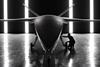















Helsing has unveiled the first new product since it purchased military trainer specialist Grob Aircraft earlier this year – an all-European unmanned combat air vehicle (UCAV).
Revealed at Grob’s production site in Tussenhausen, Bavaria on 25 September, the CA-1 Europa is a single-engined jet which Helsing says was conceived and built within only a 14-week technology study period.
First flight is being targeted for 2027, with the system to rely on Helsing’s Centaur artificial intelligence (AI) technology and open system software.

“The production version is expected to be operational within the next four years,” the company states. It adds that it is “working with leading players in the European manufacturing ecosystem to build the aircraft with a focus on scalability and a resilient European supply and logistics chain”.
Wolfgang Gammel, managing director of Grob Aircraft and Helsing Germany, describes the product as an example of a pursuit of “technological sovereignty – from Europe, for Europe”.
“The partnership is perfect,” he says. “Grob has decades of experience and is globally recognised in the construction of light, durable composite aircraft – the ideal platform for what we intend to achieve.”
Helsing describes its design as having a maximum take-off weight of 4,000kg (8,820lb): similar in size to the early-increment Collaborative Combat Aircraft now being developed for the US Air Force. Its CA-1 has an 11m (36ft) fuselage length and 10m wingspan.
“Engineered for fully autonomous operations in contested and denied environments, the platform will deliver precise effects through advanced AI and survivability capabilities,” Helsing states.
The company already has made an engine selection for the vehicle – which will have “high-subsonic speed” performance – but is not announcing its choice at this time, says Stephanie Lingemann, senior director, programmes.

After entering flight testing in 2027, Lingemann expects the Europa to be regularly flown from Grob’s remote Tussenhausen site.
“This will give us a lot of possibility to continuously test and iterate, and really develop in a lean and fast fashion,” she says.
Potential applications for the attritable vehicle include surveillance and reconnaissance, but its design will enable it to perform a wide range of duties.
“The modular airframe will allow for rapid integration of new sensors, self-protection systems, electronic warfare equipment and effector capabilities,” Helsing says.
“We believe that for the threats that are coming and for the independence that we require, Europe needs to be able to control the software and when things are updated,” says co-chief executive Torsten Reil.
“The threat that is coming from the east is imminent,” he says, referring to the actions of Russia and China. “We have to feel a sense of urgency and realise that we have to get this into the air and into operation as quickly as possible.”
An operational UCAV will cost “a fraction of a fighter jet,” he adds.
Also speaking at the unveiling event, company co-chairman Tom Enders noted: “Helsing’s founders were the first in Europe to recognise that AI can revolutionise everything in the military.”
Describing it as a “Bavarian unicorn”, the former EADS and Airbus chief executive likens the potential of the company – which was established in March 2021 – to that of the start-up Airbus in 1970.
“Within a few years, fighter pilots without AI won’t even go up into the air,” he argues.
Helsing’s acquisition of Grob Aircraft from previous owners H3 Aerospace was announced in early June, with the process finalised the following month.
“The collaboration [on the Europa] started before the acquisition – we worked very closely with Grob before,” Reil says. “That led us to develop the conviction that this is a great combination, which is turning out to be the case.”
Meanwhile, the Europa programme has secured strong support from minister-president Dr Markus Soeder, head of the Bavarian state government, who describes the combination of drones and AI as “a crucial future competency”.
“We must massively increase our defence capabilities. This is also demonstrated by incidents such as the intrusion of drones into NATO airspace by Russia on NATO’s eastern border,” he says.
“Bavaria is committed to defence,” Soeder says, adding: “as many defence contracts as possible should come to the free state. With our own defence law, we will give defence companies preferential treatment in licensing and bureaucratic matters, as well as in cooperation with universities.”
Referring to the German government’s commitment to boosting defence spending, Reil notes: “Whereas in the past we have complained about the speed of these processes, we are seeing pretty significant improvements now. There is a sense of urgency that is visible everywhere – we know that we need these systems ready to deter.”
Story updated on 29 September with CA-1 Europa dimensions, plus additional quotes.