



















Rolls-Royce has confirmed that ground tests of its new narrowbody-sized UltraFan 30 demonstrator engine will be funded by the EU’s Clean Aviation programme.
Clean Aviation on 9 September disclosed the 12 projects selected in its second phase to share a total of €945 million ($1.1 billion) in support, incorporating €378 million from the EU, which includes a Rolls-Royce-led effort called UNIFIED.
UNIFIED – or Ultra Novel and Innovative Fully Integrated Engine Demonstrations – is one of three projects within Clean Aviation’s ultra-efficient short-medium range aircraft workstream that will receive a combined €199 million in EU funding.
Through UNIFIED, Rolls-Royce and its consortium partners – understood to include Airbus – will build a narrowbody-scale UltraFan demonstrator, bringing it to full ground test, and technology readiness level (TRL) 5, towards the end of the decade.
Its goal is to demonstrate a fuel-burn reduction of 20% over current state-of-the-art engines, proving the technology for 2035 service entry.
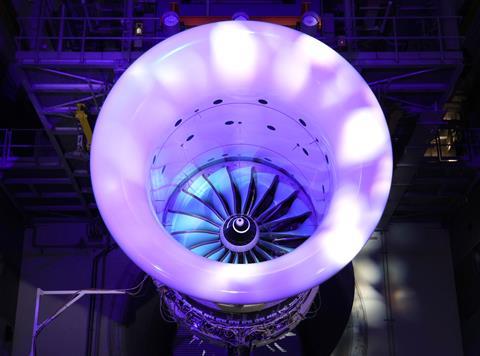
Rolls-Royce confirms the engine to be tested in UNIFIED will be the UltraFan 30 demonstrator it disclosed earlier this year.
In June, the UK propulsion specialist said it was preparing a new narrowbody-sized test asset, which it referred to as the UltraFan 30 to distinguish it from the original widebody-powering UltraFan 80.
The new naming convention refers to the broad thrust classes of each engine, with the UltraFan 30 sized to deliver around 30,000lb-thrust (133kN) and the UltraFan 80 in the region of 80,000lb.
Rolls-Royce says there is “no plan” to build another narrowbody-sized demonstrator, adding: “UNIFIED will enable the required ground testing of the technology demonstrator.”
No details of the fan size or the exact thrust of the UltraFan 30 have been revealed. However, speaking to FlightGlobal in June, Alan Newby, Rolls-Royce director of research and technology, said the demonstrator’s fan diameter would be “pushing towards 90 inches” – around 10in (25cm) more than current-generation narrowbody engines.
Critically, in addition to the ground testing, UNIFIED will also “enable the preparation of key activities towards future flight testing of the UltraFan architecture”, Rolls-Royce says.
These will include design of the flight-test vehicle, the instrumentation required, and work towards flight clearance for the powerplant.
Clean Aviation has yet to disclose the exact funding allocated to the UNIFIED consortium – more detail is set for release in November. But in its project call earlier this year it proposed providing €70 million for the work on an ultra-high bypass ratio engine, a figure that will be more than matched by private-sector investment.
UNIFIED is led by Rolls-Royce Plc – the UK parent company – but it says “the work will be carried out primarily across our sites in the UK and Germany and will draw on Rolls-Royce’s global engineering capability.”
Clean Aviation has yet to reveal the additional members of the UNIFIED consortium. Work on the phase 2 projects is expected to start in 2026.
Ground testing of the original widebody-sized UltraFan demonstrator wrapped up in 2023 after almost 70h of run time.