














Recent demonstrations show how relatively simple quadcopter drones can be integrated with sophisticated conventional weapon systems like the F-35 fighter to form what military planners call a kill chain.
The Pentagon is testing the feasibility of using quadcopter drones to support precision air-to-ground strikes by fixed-wing tactical jets.
Small, cheap quadcopters have proven to be deadly effective in the Russia-Ukraine war, using the flexibility of their vertical take-off and landing (VTOL) capability to spot targets for conventional artillery strikes or act as direct-attack weapons.
Despite those successes, the US military has been relatively slow to adopt the commercial derivative technology for battlefield use, instead relying on existing large uncrewed aircraft for reconnaissance and precision strike.
However, a recent directive from defence secretary Pete Hegseth aims to change that, dramatically expanding procurement authority for small drones and growing the roster of US companies approved to provide such vehicles for military service.
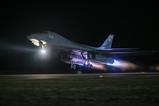
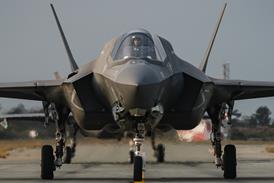
A recent test involving one of the Pentagon’s Lockheed Martin F-35 stealth fighters has demonstrated how the relatively simple quadcopter can be integrated with sophisticated conventional weapon systems to form what military planners call a kill chain.
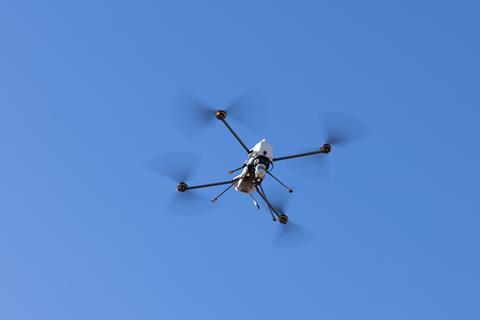
Manufacturer Precision Drone Works (PDW) says it recently proved the ability of its C100 quadcopter to integrate with the F-35 to identify ground targets for air-to-ground strike.
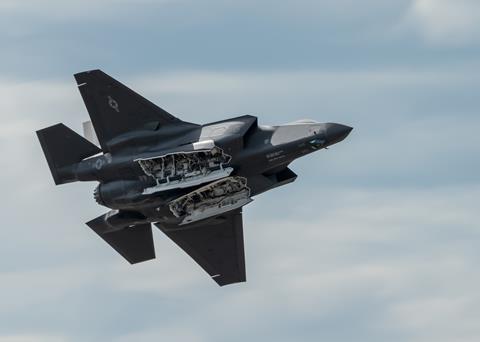
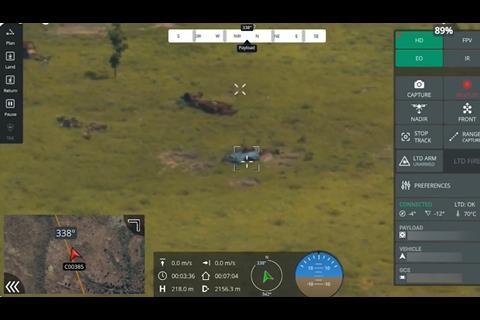
In the test, a C100 equipped with a Leonardo STAG5 laser designator successfully guided four GBU-12 precision-guided bombs dropped by an F-35 onto designated targets.
The demonstration featured three separate engagements at ranges of 1,000m, 1,500m, and 2,000m of stand-off between the C100 and target.
The quadcopter also showed the ability to loiter in the area for 35min at a distance of some 1.6nm (3km) away from its remote operator, sending back live imagery to enable target identification and acquisition.
PDW says the test serves as proof of concept for the C100, which was designed to provide ground troops with a flexible platform able to support a range of missions, including target designation, reconnaissance and kinetic strike.
“The C100 offers a huge leap in tactical flexibility for the war fighter and PDW is ready to equip our forces with a system that can provide that support across various domains,” says PDW chief executive Ryan Gury.
Critically, the quadcopter’s range and endurance allows the operator to remain well removed from enemy forces. That type of stand-off is increasingly viewed as essential to survival in the modern battlefield, where complex webs of sensors and long-range precision fires can quickly identify and target friendly forces – find, fix and finish in Pentagon parlance.
In addition to enabling stand-off, the VTOL C100 can also launch from cover and approach a potential target low and slow, a potential advantage over larger fixed-wing UAVs that fly at higher altitudes.
Large numbers of low-cost quadcopters offer the prospect of connecting multiple kill chains into a “kill web” network, featuring dozens of sensors and strike platforms that offer multiple pathways to achieving a kill.
The C100 was selected by the US Army in 2024, alongside the Ghost X from Anduril, to quickly deliver a commercially available small drone to frontline ground combat units. The 10-year, indefinite-quantity contract was worth up to $14.7 million.
Since then, the army has released multiple images of American soldiers deploying the C100 as part of exercises in North Africa and the continental USA.
The US Marine Corps has also tested the C100 at the service’s Twentynine Palms training area in California.