









A prominent Chinese aircraft designer has highlighted the importance of advanced technologies for future fighters, as more images emerge showing Beijing’s naval aviation ambitions.
Artificial intelligence and the ability to work with unmanned aircraft will be key for future fighters, according to Sun Cong of the Chinese Academy of Engineering.

In future, combat aircraft “should be produced like mobile phones”, suggesting that the production rate for Chinese aircraft will grow. In addition, the software aboard aircraft will need to easily updated – as with mobile phones – which allows for the swift addition of new capabilities.
“With advances in technology, China’s carrier-based aircraft will become more intelligent in the future,” he says.
The USA is also interested in rapidly updating software on combat aircraft. In June 2023, the US Air Force demonstrated the ability to rapidly update and deploy software for the Lockheed Martin F-22 and F-35 fighters, offering greatly improved flexibility for rapidly evolving tactical situations.
Sun’s remarks were cited by the Global Times propaganda outlet, which cited an interview with Sun on state television. The report cites Sun as the designer of the new AVIC/Shenyang J-15T, a variant of China’s main naval fighter designed to operate from CATOBAR (catapult-assisted take-off but arrested recovery) aircraft carriers.
And whereas the J-15 – a Chinese copy of the Sukhoi Su-33 – is designed for manoeuvrability and the employment of weapons, the new J-35 is designed for “informationisation”, in which the aircraft plays a key role in Chinese “kill-webs”.
His views echo remarks made in May, during which an official at state aviation company AVIC suggested that the land-based J-35A, a type entering service with the People’s Liberation Army Air Force, is designed to support kill chains against enemy stealth aircraft.
Sun also hinted at a possible concern in China that the country may be falling behind developments in Western combat aircraft: “But if other countries start introducing new innovations every five years, we’ll quickly fall behind at our current pace.”
Sun’s remarks come amid a spate of recent sightings of Chinese naval aircraft on Chinese social media.

These include crisp shots of the developmental Xian KJ-600 airborne early warning and control (AEW&C) aircraft, which is designed to operate from future CATOBAR carriers. An image of the aircraft bearing registration 7106 highlights its resemblance to the Northrop Grumman E-2 Hawkeye, although the aircraft lacks People’s Liberation Army Navy (PLAN) markings and a tailhook.
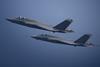
Fresh photos have also emerged of a pair of J-35s in flight.
Both the J-35 and KJ-600 are destined for service aboard China’s new aircraft carrier, CNS Fujian. The vessel is still undergoing testing, and it is not clear if flight trials have already commenced.
The PLAN’s two operational carriers, CNS Liaoning and CNS Shandong, use a ski-jump ramp to launch aircraft, which limits the payloads aircraft can launch with. It also precludes the operation of AEW&C types.
Fujian is a larger and more advanced carrier, featuring three electromagnetic launch systems (EMALS) like those found on the US Navy’s latest carrier, USS Gerald Ford.
EMALS allows heavier aircraft with more fuel or weapons to launch from shorter decks, unlike ski-jumps which limit take-off weight.