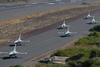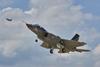













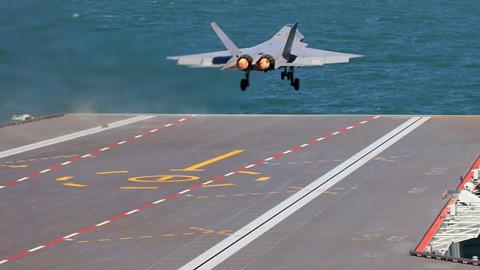
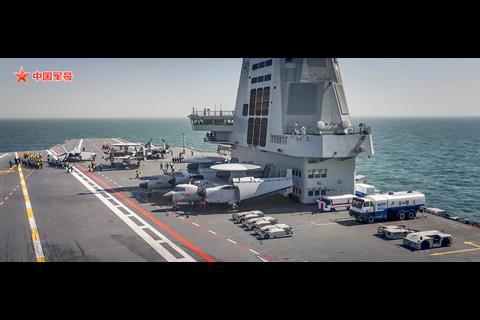
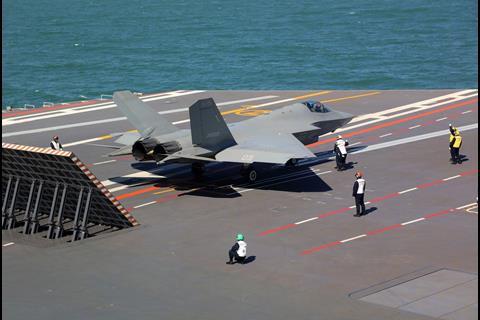
China’s navy has commenced flight tests from its new CNS Fujian aircraft carrier, with three different types shown taking off using the vessel’s electromagnetic launch system (EMALS) and conducting arrested landings.
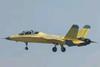
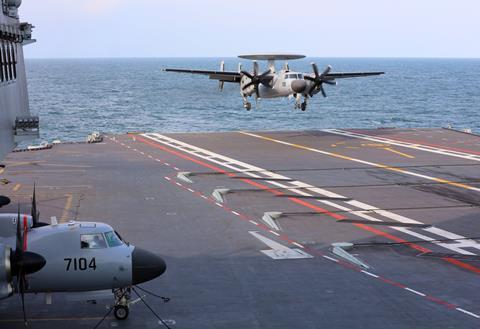
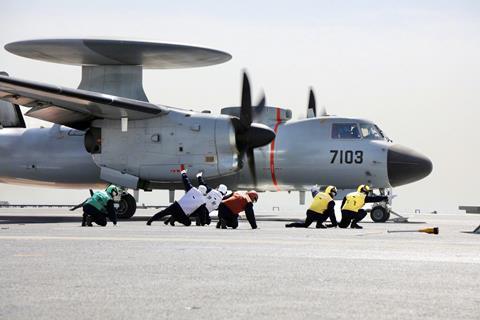
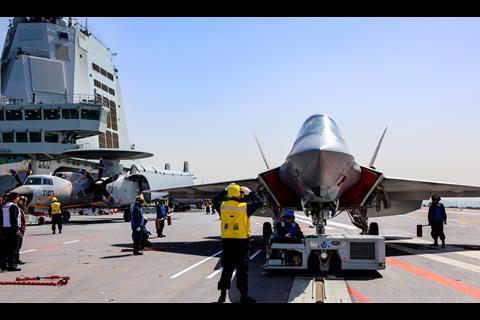
In videos posted on-line, the AVIC Shenyang J-15T and J-35 fighters are shown launching with EMALS, as is the Xian KJ-600 airborne early warning and control (AEW&C) aircraft. The types are also shown ‘trapping’ using Fujian’s four arresting wires.
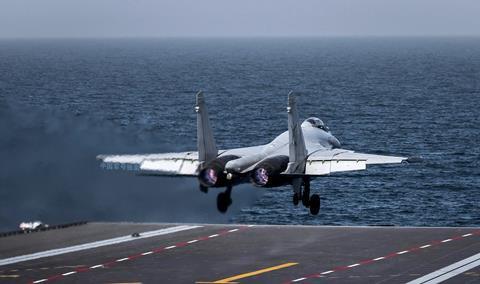
Footage also shows the fighters going up and down on the elevator that accesses the ship’s hangar bay. It is not clear when the footage was filmed, but Fujian is understood to be underway in the South China Sea near the island of Hainan.
With a displacement of 80,000t Fujian is the largest warship that any Asian nation has ever constructed. In size, Fujian is only surpassed by super carriers deployed by the US Navy (USN).
While Fujian is nearly as large as the USN’s 100,000t Gerald R. Ford class and 97,000t Nimitz class, it is not quite as capable. American super carriers have four catapults while Fujian has just three. This will limit sortie generation.
Naval analyst Ridzwan Rahmat of Janes, a defence publication, has also observed that the jet blast deflector for Fujian’s central EMALS appears to impinge on the flightdeck’s landing area, which could limit the ship’s ability to conduct simulatenous landings and launches.
The US vessels are also nuclear powered, giving them all but endless endurance. Fujian relies on steam turbines and diesel generators. This will likely limit its deployment to waters relatively close to China.
Still, in its 2024 report to Congress, the US Department of War – then called the Department of Defense – said that China has made significant progress with underway replenishment ships, which will support longer deployments by Chinese ships, including aircraft carriers.
Fujian also offers a major boost in capability over China’s two existing carriers, CNS Liaoning and CNS Shandong, which are STOBAR (short take-off but arrested recovery) vessels that rely on a ski jump ramp to launch fixed-wing aircraft.
While far easier to operate than a CATOBAR (catapult assisted take-off but arrested recovery) vessel such as Fujian, a STOBAR carrier’s ramp restricts aircraft take-off weights and precludes the use of important support aircraft, specifically fixed-wing AEW&C platforms such as the KJ-600.
The KJ-600 is likely to serve a key battle management role like that of the USN’s Northrop Grumman E-2 Hawkeye. On China’s existing carriers the airborne early warning mission is performed by the Change Z-18J helicopter, a far more limited platform.
It is also believed that a COD (carrier on-board delivery) variant of the KJ-600 is in the works, which will eventually allow vital equipment and personnel to be flown to Fujian. In the USN, the COD role is performed by the Bell Boeing CMV-22 Osprey tiltrotor and the ageing C-2 Greyhound, which is based on the E-2.
The Pentagon’s 2024 report gave significant coverage to China’s carrier ambitions, adding that vessels beyond Fujian will be produced.
Fujian and other Chinese carriers are likely to play a major role in any Chinese effort to invade neighbouring Taiwan. Operating to the east of Taiwan and operating with surface combatants and submarines, they will greatly extend China’s A2/D2 (anti-access/area-denial) bubble deep into the western Pacific.

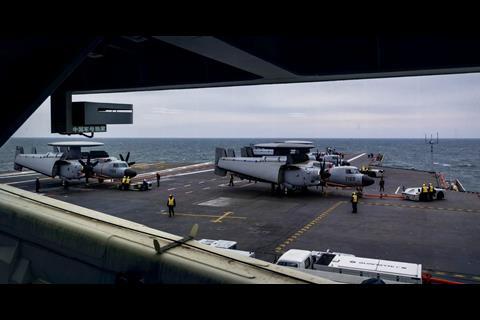
Given the threat posed by submarines, the Changhe Z-18F anti-submarine warfare (ASW) helicopter is optimised for operations from larger ships such as Fujian and China’s growing fleet of amphibious assault ships. In addition, the smaller Harbin Z-20F – a type that resembles the Sikorsky SH-60 Seahawk – can perform the ASW role from smaller Chinese surface combatants.
The ASW helicopters will receive support from land-based types such as the Shaanxi Y-9FQ, which is understood to have entered service in 2023.
When fully operational, Fujian will present a challenging dilemma to defence planners in rival nations such as Japan, Taiwan, and the USA.
A fixed-wing AEW&C capability in the form of the KJ-600 will offer Chinese naval commanders unprecedented situational awareness.
Moreover, the J-15T and stealthy J-35 are understood to be equipped with active electronically scanned array radars and will carry advanced Chinese air-to-air and air-to-ground munitions. EMALS will allow them to launch with heavier fuel and weapons payloads.
China’s investment in robust airborne ASW capabilities – which will operate under the protection of friendly fighters – will create issues for submarines attempting to approach Chinese surface ships.
The advent of Fujian’s EMALS launch capability sees the People’s Liberation Army Navy enter a new era, with the nascent capability to operate on equal terms with USN carrier strike groups.