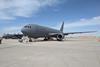













Less than two months after the US Air Force (USAF) announced plans to significantly expand its purchases of KC-46A tankers from Boeing, US lawmakers are attempting to restrict that proposal, at least temporarily.
The annual defence authorisation bill passed by the US House of Representatives last week would limit changes the USAF can make to its fleet of aerial refuellers.
Tanker provisions in the bill include restrictions on retirements of Boeing KC-135s, temporary limits on the purchase of the newer KC-46A, and increasing the mandatory size of the aerial refuelling fleet.
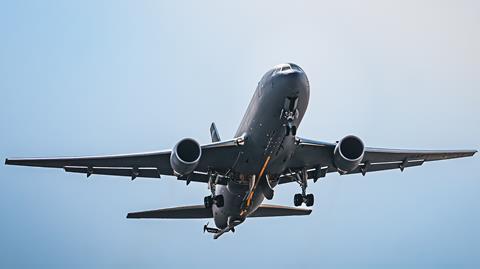
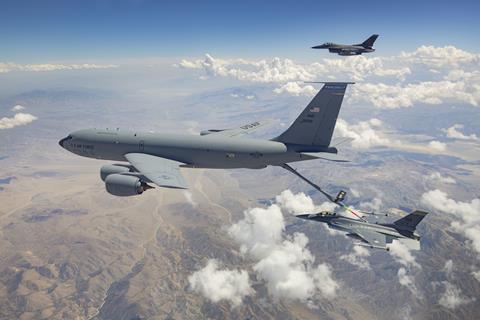
The draft 2026 National Defense Authorization Act (NDAA) bill would expand the statutorily required USAF tanker fleet from 466 aircraft to 504 by 2027. This would be accomplished in part by limiting further retirements of the ageing KC-135 Stratotanker, which the USAF is now replacing with KC-46s.
Any KC-135s assigned to frontline aerial refuelling squadrons in the USAF Reserve would be barred from retirement under the bill.
Additional restrictions on divestments of Boeing KC-10 tankers would take effect if the USAF fails to meet its mandatory fleet minimum of 485 aircraft by October 2026 and of 504 aircraft by 2027.
Any Boeing KC-10s decommissioned while the fleet is less than that level must be stored “in flyable condition”, with the ability to be returned to duty in a tanker role. That includes a mandate to retain each KC-10’s in-flight refuelling boom and a prohibition on using the tri-engined jets as a source of spare parts.
At the same time Congress is seeking to keep legacy tankers flying longer, lawmakers are looking to slow the air force’s acquisition of the newer KC-46.
Citing unaddressed engineering deficiencies with the Boeing 767-derivative, lawmakers included a provision in the NDAA limiting KC-46A acquisitions to 183 examples until the Pentagon “has developed and is implementing a plan of corrective actions and milestones to resolve all Category 1 deficiencies identified with respect to KC-46 aircraft”.
Category 1 is the USAF’s most-severe category of design failure, denoting issues that could cause severe injury or death to personnel, or the loss of aircraft.
The KC-46 has notched at least six Category 1 deficiencies in recent years, including problems with the stiffness of the fuel transfer boom, visual washout of the remote camera system used by boom operators to offload jet fuel and excess vibration from from the fuel pump.
Faults with the Remote Vision System were cited in a recent accident report released by the USAF covering three serious KC-46 mishaps that occurred since 2022, with the camera system explicitly blamed in at least one case. Operator error was determined to be the primary cause of one incident and a contributing factor in the other two.
Boeing is working toward re-engineering permanent solutions to the defects, while also rolling out temporary fixes that have allowed the KC-46 to enter frontline combat service globally. The tanker is believed to have played a critical role in assisting US fighters and bombers on the transoceanic mission to bomb Iranian nuclear development sites in June.
Before allowing the USAF to buy more than 183 KC-46s, Congress wants to see a plan for addressing the remaining engineering deficiencies, including an estimate of total cost and a “realistic event-driven schedule”.
In July, the air force announced plans to expand its total KC-46 acquisition target to as many as 263 aircraft. Boeing was initially contracted to provide 179 of the twinjet tankers.
That expansion would be permitted to go forward so long as the USAF submits a plan for rectifying the type’s flaws.
Both the House and US Senate must pass the NDAA, and President Donald Trump must sign it, before it becomes law.
Members from the two chambers are set to meet before October to negotiate final text.