















Raytheon is ramping toward the start of rate-production later this year on the company’s PhantomStrike lightweight fire control radar.
Pre-production deliveries of initial PhantomStrike units are already underway to launch customer Korea Aerospace Industries, who will feature the active electronically scanned array (AESA) radar unit on FA-50 light attack fighters ordered by Poland.
In Raytheon’s home market, the US Air Force has opted to install the PhantomStrike on its X-62 Variable Stability In-flight Simulator Test Aircraft (VISTA) – a modified Lockheed Martin F-16D Block 30 being used to test autonomous flight technologies.
Raytheon is positioning the air-cooled, Gallium Nitride sensor as a modern fire control radar with a significantly lower price, power requirement and physical footprint than comparable alternatives.
While the PhantomStrike will first fly aboard a conventional fighter, Raytheon developed the new radar with uncrewed platforms in mind.
“We saw the market shifting and moving more towards the unmanned aircraft,” says Rob Smith, vice-president of radio frequency solutions at Raytheon.

The new generation of autonomous tactical jets already being developed in the United States, Australia, Turkey and South Korea will be significantly smaller than traditional fighter aircraft, with less physical space and onboard electrical power to support sensors like a fire control radar.
Those jets, known as Collaborative Combat Aircraft, also have much lower price targets than high-end manned fighters. The onboard radar is a significant driver of cost for any tactical aircraft, making a low-cost sensor appealing to developers such as Boeing, KAI, Northrop Grumman, Anduril Industries, General Atomics and Turkish Aerospace Industries.
“We really needed to do a clean sheet design and build the radar with that market in mind,” Smith says.

The PhantomStrike runs on 5.5kW of power – roughly half the requirement for a typical AESA radar, according to Smith. It also clocks in at half the weight of other available sensors, owing to the use of air rather than liquid cooling.
To achieve the reduced size target, Raytheon opted to vertically integrate much of the PhantomStrike’s supply chain, designing and producing many subcomponents internally.
The American defence giant also operates its own laboratory for churning out Gallium Nitride – a high-performance semi-conductor that allows more electrical power to be pumped through a radar antenna, providing increased range and performance.
Deliveries of production model PhantomStrike units are expected to begin sometime in the first half of 2026.
While KAI is the first buyer, Smith says Raytheon is “very close” to announcing finalising contracts with additional buyers. Discussions are underway with potential customers in Asia, Europe and the USA.
He notes the system has performed well in FA-50 flight testing, including both air-to-air and air-to-ground modes.

The PhantomStrike has notably been approved for direct commercial sales, meaning interested buyers do not need to navigate the US government’s lengthy and bureaucratic Foreign Military Sales process.
While new-build fighters and CCAs are one target, the upgrading of existing fleets represents a “potentially a larger market”, Smith notes.
He notes the PhantomStrike represents a compelling option for quickly and affordably upgrading those older generation aircraft, which have more limitations on available power.
With the US Air Force planning to outfit the X-62 with a PhantomStrike later this year, operators of legacy model F-16s are an appealing target market for Raytheon.
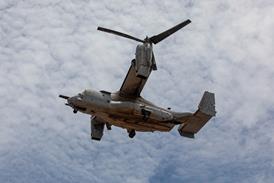
The PhantomStrike will also be compatible with a range of other fighters, uncrewed aircraft and rotorcraft.