












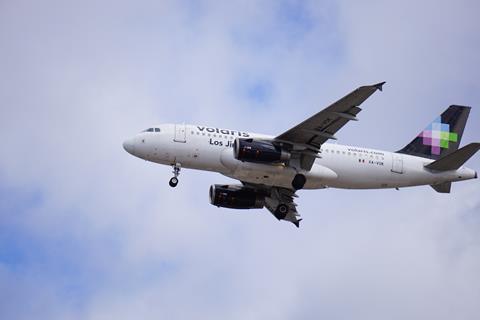
Volaris has officially ceased operating Airbus A319s, a type that once made up more than half of the Mexican discounter’s fleet.
”Our fleet strategy is to evolve,” chief financial officer Jaime Pous said on 28 October. “To this end, last month we phased out the last of our A319s from operations.”
Volaris operated a trio of 144-passenger A319s as of 31 December 2024, according to the company’s year-end 10Q filing with the US Securities and Exchange Commission.
The Mexico-City based ultra-low-cost carrier (ULCC) operated about 25 A319s when it launched its initial public offering in 2013 but has been steadily replacing the smaller narrowbodies with larger and more-efficient A320neos in recent years.
”Over the past 10 years, we have continuously adapted to become more efficient, and we are committed to continue doing so in the decade ahead,” Pous says.
Volaris still operates dozens of older A320s, though the carrier’s share of latest-generation A320neo-family aircraft will eventually increase as it holds an 122-aircraft-strong orderbook with Airbus. About 85% of its incoming jets are A321neos.
The ULCC expects 12-13 new aircraft deliveries from Airbus in 2026, as well as some older aircraft from lessors. Overall, it is budgeting to take 17 deliveries next year.
Pous says Volaris has the option to “realign our delivery schedule” to ensure modest, single-digit annual revenue growth, including by extending leases on currently operating aircraft, if warranted.
“Current market conditions have greater opportunities to acquire aircraft for re-delivery on attractive terms, helping reduce future delivery expenses and extending time on the assets,” he says.
During the third quarter, Volaris re-acquired two formerly leased A320s and returned them to service.
All incoming jets will help Volaris manage the ongoing engine availability issues that continue to plague the ULCC. Volaris averaged 36 grounded Airbus jets during the third quarter, a result of Pratt & Whitney’s geared turbofan (GTF) recall that requires engines to spend hundreds of days off-wing.
Mexico City-based Volaris has been among the world’s most-exposed carriers to P&W’s turbofan recall, as about two-thirds of its 152-aircraft fleet is comprised of newer Airbus A320neo and A321neo jets. The ULCC has grappled with dozens of grounded aircraft on a rolling basis since 2023, with those assets effectively sidelined from generating revenue.
Volaris says it is looking forward to “efficiently reintegrating” A320neo-family jets into its fleet, providing a passenger-capacity tailwind as more airline seats become available.
For example, Volaris expects 8% capacity growth in the fourth quarter, driven at least partially by jets returning from lengthy shop visits. Notably, Volaris says that its full-year and fourth-quarter outlooks account for “compensation that Volaris expects to receive for the projected grounded aircraft resulting from the GTF engine inspections”.
Chief executive Enrique Beltranena says that Volaris expects to average 32-33 grounded jets early in 2026, with further reductions in the number of grounded aircraft as the carrier moves toward 2027.
Beltranena has previously said that he expects to continue working through “carefully planned” engine removals through at least 2027.
Volaris has had a compensation agreement with P&W in place since December 2023, covering each engine that requires time off-wing for inspections and potential repairs. That deal covers most of Volaris’ fixed costs but does not cover revenue lost as a result of out-of-service aircraft.
Volaris is not alone in suffering acutely from GTF-related aircraft groundings. Monterrey-based ULCC VivaAerobus averaged 29 grounded A320neos and A321neos during the third quarter, contributing to 18% higher operating costs.
That carrier expects to receive compensation from P&W to partially cover the cost of groundings in the fourth quarter.