













Brazilian investigators have disclosed the sequence of events that led to the ditching of an Airbus Helicopters H160 off the coast of Brazil in early January, although they are yet to reach a conclusion for the fatigue failure of a critical part of the main rotor assembly.
Having departed from Cabo Frio airport near Rio de Janeiro on 2 January with two pilots and six passengers on board, the crew of the twin-engined helicopter was forced into an emergency landing around 21min into the flight.

Take-off, climb and the initial part of the cruise were completed “without any incident”, Brazilian investigation authority CENIPA says in its preliminary report into the ditching.
However, around 40min into the flight, while at 4,500ft and 130kt (240km/h) “the aircraft exhibited high-amplitude vibrations, along with variations in attitude and speed”, which “made it difficult for the pilots to control”.
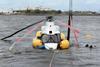
Faced with this issue, they opted to perform an emergency landing on the sea, with all occupants safely exiting the aircraft.
Subsequent examination of the H160 (PR-OFB) following its recovery – it was towed to port and then lifted out of the water – revealed a rupture at the upper rod end of a pitch-change rod assembly on one of the helicopter’s five main rotor blades.
Each rod alters the pitch of a main rotor blade, transmitting pilot inputs via the swash plate to the blade root; it is connected to those components via bearing assemblies that are threaded onto either end of the rod.
Images taken from the H160’s tail camera show the rupture occurring during the flight, the investigation agency says. The time between the incident onset and the landing on water was just 1min 30s, it notes.
Both upper and lower rod-end bearings were found broken, with the upper having failed first.
“For the next few seconds, the white blade pitch-change rod, still connected to the swashplate by the lower rod end bearing, struck the main gearbox cowling several times. These impacts continued until the lower bearing also broke,” it discloses.
CENIPA says the rod was later recovered from inside the main gearbox cowling of the airframe.

Due to the motion of the blade following the pitch rod failure it sustained “substantial structural damage”, while the main rotor lower stop was fractured.
Examination of the upper rod end bearing using an electron microscope revealed a failure “consistent with fatigue”, with no evidence of another crack initiator such as corrosion pits or impact damage.
Permanent deformation of the upper bearing of about 2.5° was also observed, the report says, noting that the “the failure initiation area was situated in the compressed side of the deformation”.
Additional tests are now ongoing to identify the source of the bending, CENIPA adds.
CT Scans also showed a second crack just below the first, later examination of which showed signs of material fatigue failure. Four microscopic cracks at the root thread were also discovered.
The lower rod end bearing, meanwhile, “showed signs consistent with overload failure”.
In the immediate aftermath of the ditching, and prior to the results of the laboratory examinations, Airbus Helicopters issued an emergency service alert bulletin to operators, later made mandatory by the European regulator, requiring the replacement of all upper and lower rod end bearings on each main rotor blade every 165 flight hours.
Damage found to the tail rotor transmission shafts appears to have been caused by the impact of the fenestron shrouded tail rotor with the sea, the investigators add.
Images from the tail camera “showed that the tail rotor transmission shafts broke shortly after the fenestron touched the water during the ditching”, it says.