










The aviation industry this week will be watching the US National Transportation Safety Board (NTSB) for updates into probes of three recent deadly US aircraft crashes, while also waiting to see how president Donald Trump’s cost-cutting initiatives might impact the Federal Aviation Administration (FAA).
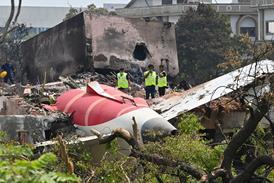
The NTSB last week recovered parts of the MHIRJ CRJ700 and US Army Sikorsky UH-60 Black Hawk that collided over the Potomac River near Washington, DC on 29 January, killing all 64 people on the regional jet and all three on the helicopter.
Attention now to turns why the Black Hawk was seemingly flying higher than it should have been. And while the NTSB will likely release more facts in the coming days, perhaps shedding light on circumstances, the agency is unlikely to draw conclusions any time soon.
Investigators are also probing the 31 January crash of a Learjet 55 in Philadelphia that killed all six people aboard and at least one person on the ground, and that of a Cessna 208B in Alaska on 6 February that killed all 10 occupants.
Also of note is that US transportation secretary Sean Duffy said last week he has talked aviation with the Elon Musk-led Department of Government Efficiency (DOGE) – the department pouring through the books of other federal agencies, seeking to eliminate programmes deemed by Trump’s team as wasteful.
The US aviation industry is now waiting to hear what changes DOGE might bring to the FAA.
On the manufacturing front, news broke on 8 February that Airbus no longer intends to develop a hydrogen-powered passenger aircraft for mid-2030s service entry – a major shift for a company that had been pinning carbon-reduction targets to large degree on its ZEROe hydrogen programme.
Airbus insists it remains “committed” to the hydrogen in the long term but says infrastructural and technological challenges must be overcome.
The industry is also watching Honeywell closely following news on 6 February that it will spin off its aerospace business into a standalone publicly traded company – following the lead of General Electric, whose break-up spawned GE Aerospace as a distinct company in 2024.
Analysts view that plan favourably, saying Honeywell’s aerospace division suffered under its conglomerate parent and that a an aerospace-focussed business could allow for more investment and nimbler management.
Separately, attorneys for victims of two 737 Max crashes are hoping that new US attorney general Pam Bondi intervenes with negotiations between Boeing and the US Department of Justice over the airframer’s proposed plea agreement to charges that it defrauded the FAA.