












At the Seoul ADEX defence show, a leader in Korean Air’s unmanned systems business outlined progress with several key programmes.
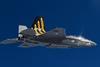
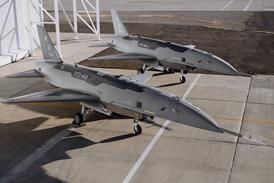
The highest-profile unmanned system in the Korean Air stable is the developmental Low Observable Unmanned System (LOWUS) collaborative combat aircraft (CCA).
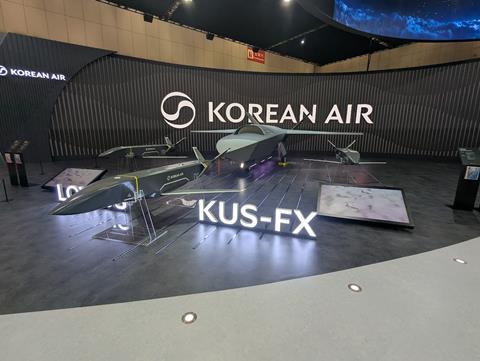
The first LOWUS aircraft, in an initial Block 1 configuration, has been delivered to South Korea’s Agency for Defense Development (ADD) and is undergoing ground tests, according to Kilho Lee, head of UAS Business Development at Korean Air.
Lee says that the aircraft, which featured prominently in the company’s large ADEX stand, will have its maiden sortie in 2026.
The aircraft is powered by a Ukrainian-produced turbojet engine with a thrust output of 5,500lb (24.5kN), but a local powerplant is in development by the ADD and Hanwha Aerospace.
Korean Air has a large team working on the aircraft’s autonomous capabilities. In August, it also entered into a partnership with US defence firm Anduril Industries to work on autonomy systems.
The Block 1 LOWUS aircraft will conduct flight testing in 2026, followed by manned-unmanned teaming (MUM-T) work in 2027. Initial MUM-T work will see the LOWUS operating with a Korea Aerospace Industries (KAI) KT-1 basic trainer.
The Block 2 LOWUS will be somewhat larger and can carry weapons internally. Should Seoul obtain the LOWUS, it will do so in the Block 2 configuration.
The Block 1 development project will be completed in 2027, setting the stage for the development of Block 2 starting in 2028, a process that could run for four years.
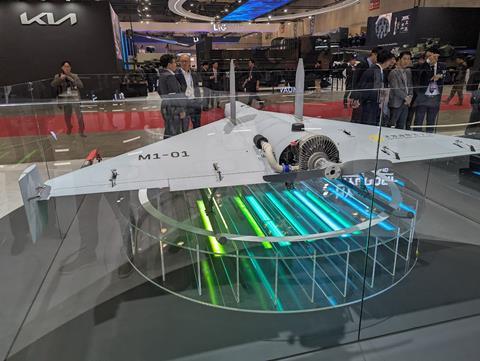
Lee adds that the Korean government has yet to indicate when the Block 2 will enter operational service, but Korean Air feels this could happen in 2032. As an operational asset, the LOWUS will be called on to operate alongside the Block 2 or Block 3 version of KAI’s KF-21 fighter, the Block 1 version of which is to enter Republic of Korea Air Force (ROKAF) service in late 2026.
Lee adds that the ROKAF’s operational concept for CCAs is likely to be broadly similar to that of its key operational partner, the US Air Force.
Like its US CCA counterparts, the LOWUS’s cost is anticipated as being a fraction of that for manned fighters. At most, the maximum cost of a LOWUS vehicle will be 20% of a manned fighter.
Complementing the LOWUS will be a smaller, expendable CCA designated KUS-FX, for which Korean Air has completed the concept design. The company is discussing the launcher with Anduril and hopes to perform a demonstration for the ROKAF in the third quarter of 2026.
The KUS-FX will perform missions such as intelligence, surveillance and reconnaissance (ISR), electronic warfare, and target acquisition. It can also act as a decoy.
Korean Air is also developing two loitering munitions. The first weighs 20kg (44lb) and has a range of 162nm (300km), while the larger one, still in early development, weighs 160kg and has a range of 810nm.
Development of the smaller loitering munition was completed in September and Korean Air is preparing mass production. The larger system, with a flight time of 12h, will be resistant to jamming, be able to recognise targets autonomously, and have a satellite communications ability that allows it to communicate back to ROKAF and navy operators.
Lee also touched on the KUS FC, a tailless conceptual CCA that Korean Air has displayed in model form at previous ADEX shows.
Lee says that KUS FC development has been paused owing to funding issues, but that this will be restarted at some point. The KUS FC will be a large aircraft, with a wingspan of 20m (65ft 6in).
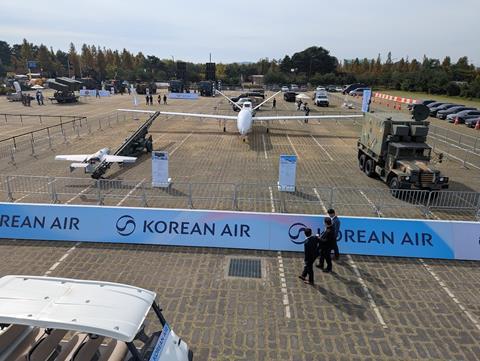
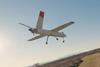
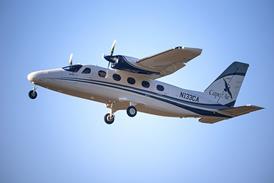
On other Korean Air systems, Lee says that the first Medium-Altitude Reconnaissance Unmanned Air Vehicle (MUAV) – also designated KUS FS – will be rolled out in November, following a December 2023 contract signing. The aircraft is optimised for performing the ISR mission against North Korea.
Five ROKAF pilots are undergoing training to operate the MUAV, with all ground and systems integration tests to be completed by the second quarter of next year, with service entry by September 2026.
The initial December 2023 contract is for 12 aircraft, and eight more are under discussion. Overall, Korean Air believes that Seoul could take up to 100 MUAVs, which it also sees being use by the navy. The platform is also seen as capable of performing in the electronic warfare mission.
Korean Air’s activities in the realm of unmanned systems were part of a broader theme at this year’s ADEX show, which emphasised autonomy and indigenous defence production.