





Bidders for a British Army project to develop an uncrewed aerial vehicle (UAV) to fight alongside its Boeing AH-64E Apaches will need to deliver a platform capable of operating autonomously while carrying a payload above 250kg (550lb) and matching the manned aircraft’s speed and range performance.

An invitation to tender (ITT) was issued to seven pre-qualified companies for Project Nyx on 26 January, which lists the Ministry of Defence’s (MoD’s) precise requirements for the capability.

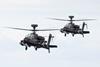
Apache Pair

Source: Crown Copyright

Project Nyx will assess autonomous companion for the British Army’s Apache attack helicopters

No detail on those requirements is publicly available, although FlightGlobal understands most of the MoD’s questions relate to autonomous technology and the ability for the Nyx aircraft to operate in a “commanded not controlled” manner.

While the ITT provides fewer specifics on platform performance, it does call for payload capability greater than 250kg, and operating parameters, notably speed and range, broadly in line with those of the Apache, FlightGlobal understands.

Boeing lists the AH-64E’s maximum level flight speed as in excess of 150kt (280km/h), although the speed for low-level nap-of-the-earth operations is much lower; range is around 270nm (500km).

The MoD calls the UAV to be developed through Nyx an “autonomous collaborative platform”, or ACP.

In an industry engagement notice released in November last year it identified likely missions for the ACP as “reconnaissance, target acquisition, strike, countermeasure defeat, and integration with launched effects”.

“The ACP will enhance the lethality and survivability of the crewed platform and do so with a smaller logistic footprint and lower maintenance burden relative to the crewed platform,” it adds.

Companies chosen to proceed to the next stage of Nyx – whittled down from a field of 18 applicants – were notified of their selection on 24 January.

These comprise Anduril, BAE Systems, Leonardo, Lockheed Martin UK, Syos Aerospace, Tekever and Thales.

So far, most of the bidders are staying silent on platforms or possible teaming arrangements.

However, BAE Systems is partnering with UK start-up Certo Aerospace for the requirement.

“We have signed a teaming agreement with BAE Systems to work together over the preparation and submission of a collaborative tender for the British Army’s requirement for an uncrewed autonomous air system to operate in conjunction with its Apache helicopters, Project Nyx,” says Certo managing director Justin Tooth.

“Due to commercial sensitivities, no further comment will be made at this stage.”

BAE has not specified which air vehicle will form the basis of its offer, but Certo has been developing a co-axial rotor-equipped UAV called Capstone, which can lift a payload of at least 275kg.

Anduril is one of the few others to have offered detail on its plans, last year revealing partnerships with a newly established UK arm of Archer Aviation and aerostructures manufacturer GKN Aerospace to address the project.

For Thales, Matt Moore, deputy sales director, says the firm is well-placed to meet the British Army’s requirements for Nyx, leveraging its experience developing the Schiebel Camcopter S-100-based Peregrine, which is operationally employed for the Royal Navy (RN), as well as Watchkeeper for the British Army.

“We have a huge amount of experience in the UK delivering safe, accredited and certified UAS capability, alongside the integration of autonomous technologies and mission systems and we continue to push the boundaries.

“Peregrine gives us a really solid foundation to work from into Nyx, offering the UK a sovereign capability and supporting domestic jobs,” he says.

Moore says the firm remains agnostic on the platform it will base its offer around while it reviews the ITT.

But should Thales again partner with Schiebel, then the latter’s developmental S-300 rotary-wing UAV would be the likely choice, given its 250kg payload.

Lockheed Martin says it would be “premature to speculate on any single or multiple partnership approach” but points to the Matrix autonomous control technologies pioneered by its Sikorsky helicopter unit as an example of its expertise in the field.

“This focus on proven, mission-ready capability underpins our commitment to the UK – strengthening sovereign defence and security while expanding industrial capacity and sustaining high-value jobs across the country,” adds Paul Livingston, chief executive, Lockheed Martin UK.

Leonardo, meanwhile, declines to comment. However, it has been honing its autonomous capabilities in the UK, notably through work on the Proteus technology demonstrator for the RN.

While many of the bidders are known quantities, Syos is somewhat of an outlier. Dual-headquartered in New Zealand and the UK, the company has developed its SA200 UAV capable of lifting a 200kg payload over an 88nm range.

“It’s great recognition of a young British company leading the way in autonomous uncrewed vehicles – we’re proud to be advancing with some of the global defence primes,” says chief executive and founder Sam Vye.

For its part, Tekever says it is “proud to contribute to a programme that reinforces national resilience, supports UK industry and helps shape the future of autonomous aviation”.

The MoD expects to move rapidly through the acquisition process, with tenders to be submitted within six weeks.

Under its plans for a “3-2-1” competition, the MoD will winnow the field down to four bidders in March, offering them contracts for initial development activity.

A further down-select will take place in the third quarter, with one or more bidders funded to build a concept demonstrator. Initial operating capability is expected in 2030.