










Defence giant Northrop Grumman is partnering with a number of burgeoning aerospace start-ups to test and mature their products on the company’s new optionally autonomous aircraft.
First unveiled in June, the Beacon project is a broad initiative to mature new autonomy technologies. At the time, Northrop described Beacon’s role as supporting the development of software for sixth-generation autonomy.
The first piece of that effort is the Scaled Composites Model 437 Vanguard – a small, low-cost jet developed by the Northrop subsidiary for optionally autonomous operations. The crewed Model 437 logged its first flight in 2024.
Now, Northrop has revealed its first cohort of partners for the Beacon project, including Merlin Labs, Red 6 and Shield AI, whose technologies will fly on the Model 437 testbed.
“Beacon is about collaboration across industry between companies of all sizes and expertise,” says Tom Jones, president of Northrop’s aeronautics division.
“By providing open access to the Beacon ecosystem, we’re enhancing the innovation, new competition and ultimately the autonomous capabilities that industry can deliver to our customers,” he adds.
![]()
The selected software firms represent a range of next-generation aviation technologies.
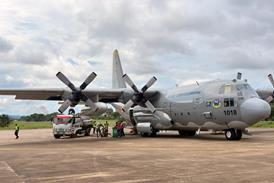
Boston-based Merlin is developing in-flight autonomy solutions for frontline US military aircraft, including the Boeing KC-135 tanker and Lockheed Martin M/C-130J, with aerial testing underway.
The company’s goal is to reduce crew workloads and use technology to better assist pilots in handing the complex and unexpected aspects of flying. A Merlin contract with US Special Operations Command aims to demonstrate the ability to safely reduce the number of onboard personnel needed to operate an MC-130J flight, though not necessarily the pilots.
“The demand for autonomous capabilities, especially in defence applications, is accelerating rapidly,” says Merlin chief executive Matt George.
“The significance of joining the Beacon project is that it allows us to validate our technology on military aircraft and in mission-relevant environments, but also enables us to test and adapt new capabilities from Northrop Grumman for future Merlin efforts,” he adds.
While Merlin aims to enable autonomy-assisted flight solutions, another Beacon participant is developing algorithmic agents to fly aircraft without any direct inputs from humans.
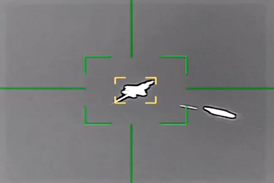
Shield AI has partnered with multiple aerospace companies as the autonomy provider for uncrewed flight projects. The company is also behind the Pentagon’s now-famous test effort that saw a heavily modified Lockheed Martin F-16 autonomously engage human fighter pilots in close-range air combat manoeuvres.
Shield AI co-founder Brandon Tseng previously told FlightGlobal its Hivemind artificial intelligence agent developed to control the X-62 jet in those tests demonstrated the ability to improvise and develop novel dogfighting tactics.
Hivemind will be incorporated into the Beacon jet under the partnership with Northrop, according to Shield AI.

Another start-up joining the Beacon project aims to make human pilots better at dogfighting, rather than replace them.
Augmented reality developer Red 6 is in the late stages of developing a helmet-mounted projection system that would allow pilots to drill against a wide range of simulated threats and environmental conditions while physically flying their primary aircraft.
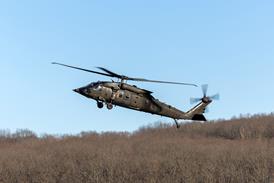
These projections could include enemy aircraft for drilling aerial combat manoeuvres, a simulated aircraft carrier to practise landings at sea, or even degraded environmental conditions such as rotorwash-produced brownout.
The company is hoping to begin production of its Advanced Tactical Augmented Reality System (ATARS) by mid-2026.
“The Beacon programme represents the future of autonomous mission development, and we’re excited to contribute,” says Red 6 chief executive Daniel Robinson.
Robinson specifically notes the partnership with Northrop will allow Red 6 to further advance its efforts to integrate crewed-uncrewed teaming into its augmented reality training scenarios.
Red 6 notes that ATARS is already incorporating autonomous collaborative platforms into its available training capabilities. That new generation of uncrewed fighters are being positioned as a centrepiece of US Air Force operations in the coming decades.
The service is preparing to launch flight testing of two prototype autonomous fighters under its Collaborative Combat Aircraft programme.
Other Beacon participants include Applied Intuition, Autonodyne and SoarTech.