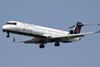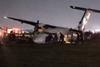













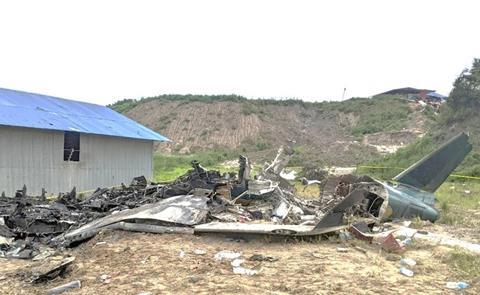
Nepalese investigators have declared that the operator of a MHIRJ Aviation CRJ200, which stalled and crashed during take-off from Kathmandu, was grossly negligent during loading of the jet.
The Saurya Airlines aircraft had been conducting a ferry flight to Pokhara for maintenance, on 24 July last year, and those on board did not follow normal check-in procedures.
As a result the amount of baggage being loaded – base maintenance equipment and materials – was unknown, and a “crude estimation” of the baggage weight was used for the loading manifest, says the Nepalese aircraft accident investigation commission.
Cockpit-voice recorder information captured ground and maintenance personnel “verbally discussing a rough baggage weight estimation” during pre-flight preparation, the inquiry states.
It adds that the baggage was “haphazardly” placed in the cabin, but neither pilot raised concerns. The distribution of weight was “not considered” when calculating the centre-of-gravity position, and the loads were not adequately secured with ties.
Investigators state that the take-off weight in the load and trim sheet was listed at 18,137kg, including a “ballpark” 600kg for baggage, while the inquiry puts the figure at around 18,300kg.
The rotation speed for the listed weight should have been 122kt – and 123kt for the inquiry’s revised figure – but an undetected error in the speed tables gave a speed of just 118kt.
Analysis shows the aircraft started to rotate at just under 120kt, and that the rate of rotation was unusually high, up to 8.6°/s compared with the typical 3°/s.
While the inquiry considered the possibility that this pitch rate was driven by weight-and-balance factors, or an abnormal centre-of-gravity, examination of flight data revealed a “repeated history” of excessive rotation rates during take-off.
It states that the sharp rotation from Kathmandu’s runway 02 was attempted at “lower than optimal” speed. The aircraft’s wings stalled and, owing to the T-tailed design, the turbulent wake reduced the effectiveness of the elevators.
“The high rotation rate occurred while the aircraft was still under the influence of ground effect, which can further reduce the stall margin,” the inquiry adds.
“As the stall happened shortly after rotation, there was insufficient altitude for recovery efforts.”
Sixteen passengers and three crew members were on board the aircraft (9N-AME), but the captain was the only occupant to survive the crash.