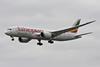














The high workload of an air traffic controller at Delhi airport resulted in two traffic collision avoidance system (TCAS) alerts between an Airbus A320 of Vistara Airlines and a Boeing 787-8 of Ethiopian Airways.

The serious incident occurred on 10 November 2023 in the late morning, as the A320 (VT-TQL) approached runway 29L, and the 787 (ET-ATL) prepared to depart on the parallel runway 29R, according to the Indian Aircraft Accident Investigation Bureau’s (AAIB’s) final report into the incident.

Ethiopian_Airlines_Boeing_787-8_Dreamliner_ET-AOQ_(24954962565)

Source: Wikimedia Commons/Kambui

The Ethiopian 787 continued to Addis Ababa after the incident

As the Vistara A320 approached, operating flight VTI946 from Ahmedabad, its crew was cleared to land on 29L and warned of windshear conditions near the airport. At roughly the same time the controller for runway 29R cleared the Ethiopian 787 for take-off, operating ETH689 to Addis Ababa.

Procedures dictated that departing flights on 29R could not take off if arriving flights on 29L were less than 90s from the runway threshold. When the 787 commenced its take off roll the arriving A320 had fallen below the 90s minimum, but the controller for runway 29R failed to respond.

Owing to weather conditions, the A320 crew decided to do a go around as the 787 became airborne.

This resulted in a horizontal separation between the two aircraft of 0.6nm (1.1km) and a vertical separation of 300ft, and triggered traffic collision avoidance system (TCAS) alerts on both aircraft.

The report indicates that another controller, responsible for approaches and departures, was “panicking upon realising the conflict”, and instructed to the 787 to stop climbing at 2,700ft and turn right on a heading of 270.

This, however, “worsened the situation”, reducing horizontal separation to just 0.2nm horizontally and 400ft vertically, and triggering a second TCAS alert on both aircraft.

The crews followed the TCAS alerts, and subsequently the Ethiopian 787 continued its flight, and the Vistara A320 made an uneventful landing.

In its analysis, the report indicates that the 29R controller had a “heavy and complex” workload dealing with other controllers and several aircraft in line to depart, hence the failure to stop the Ethiopian aircraft from departing.

Following the incident, the AAIB has recommended that Airports Authority of India (AAI) take several safety actions.

These include revising the standard operating procedures for parallel runway operations, improving meteorological information briefings, and enhancing simulator training for air traffic controllers.

Additionally, the AAIB has recommended implementing a system to record background communication at controller workstations to assist in future investigations.