














Advanced materials, thorough dust-ingestion tests and design improvements make GE Aerospace confident its most-powerful-ever engine, the GE9X that powers Boeing’s 777X family, will prove durable when operated in dusty conditions.
The company arrives at the Dubai air show stressing that message – and revealing plans to better support the Middle East’s GE9X fleet by opening, in 2027, a larger maintenance site in Dubai South.
“The GE9X is a special engine. It was really the first engine to be designed from the start with the Middle East in mind,” says GE vice-president of commercial engines and services engineering Carlos Perez, referring to the problem of dusty air degrading engine components.
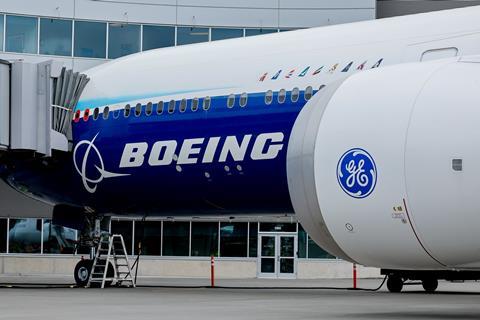
“It is the most-tested engine in our history, especially ahead of [entry into service],” adds GE9X general manager Cristina Seda-Hoelle. “We’ve been using our time wisely, continuing to test and iterate the design to ensure that when we launch this engine it is as mature as possible.”
The Middle East is a critical market for GE and its 134,300lb (597kN)-thrust GE9X, the only engine available for the badly delayed 777-9, the first 777X variant. In October, Boeing delayed first delivery of the jet again, to 2027 from 2026, citing slow certification-flight-test progress.
“Two thirds of the sales of the aircraft and engine have occurred from Middle East customers,” Seda-Hoelle adds. “This year, we’ve had great momentum on the sales side.”
Boeing has landed orders for 84 777X this year, with several deals supported by US President Donald Trump and coming together amid trade discussions.
Boeing now has 565 of the jets in its backlog, including 463 777-9s, 59 777-8 Freighters and 43 777-8s. Of those orders, Emirates holds a whopping 205, Qatar Airways holds 124 and Etihad Airways holds 25, Boeing’s data shows.
To support such customers, GE on 16 November revealed a $50 million plan to build a 11,148sq m (120,000sq ft) maintenance site at the Mohammed Bin Rashid Aerospace Hub in Dubai South, a region including Al Maktoum International, an airport pegged for major expansion and set to become Dubai’s primary aviation hub.
The site will replace and be four times larger than GE’s existing nearby maintenance facility. It will provide on-wing support for GE9Xs and CFM International Leaps (which power Airbus and Boeing narrowbodies) and perform technology development work and maintenance training for GE’s and customers’ technicians.
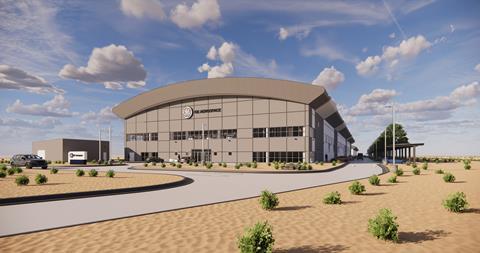
Construction will start in December and run through most of 2026, with the site being operational in 2027, GE says. “We are ensuring that our customers have access to the advanced technologies, training and field support they need to achieve operational excellence and reliability.”
The GE9X support network will also include shops in Cincinnati, Doha, London, Seoul, Singapore, Wales and Xiamen.
GE has had plenty of time to conduct GE9X pre-service trials thanks to the 777-9’s delays, which are six years and counting.
“We’ve been using our time wisely,” Seda-Hoelle says, stressing GE’s work to reduce dust-related durability issues. Prevalent in places like the Middle East, dust has long bedevilled aircraft engine makers for its propensity to degrade components.
GE in recent years poured resources into addressing dust-related issues affecting its GE90, which powers 777s, GEnx, the 787’s power, and Leaps.
To better “understand the specific chemistries and geologies” of dust, GE studied samples taken from various locations in the Middle East, then began engineering dust with similar properties for use in dust-ingestion tests.
GE has addressed the problems by rolling out durability improvements that have included tweaks to shrouds, nozzles and blades. An upgraded GEnx turbine blade roughly doubled that type’s service life when operated in the Middle East, says Perez.
The company aims for its engines to remain in service six to 10 years without significant maintenance. “That’s really what most of our customers require,” says GE’s Perez.
The company has brought lessons from the other programmes, and advances in materials science, to the GE9X, which has carbon-fibre fan blades and more than 100 ceramic matrix composite parts, executives say.
Importantly, GE is well along in the GE9X’s dust-ingestion testing regime. Several years ago it completed an initial series of tests, notable because GE had always previously completed such trials after an engine’s service entry – typically five to six years after, says Seda-Hoelle.
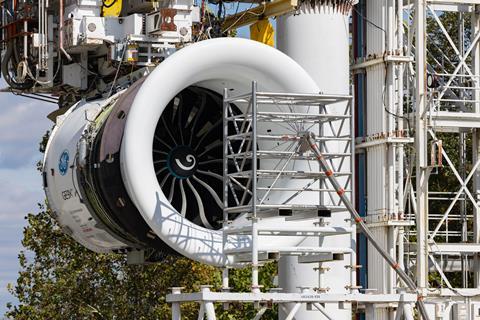
A second round of GE9X dust-ingestion tests are now underway at the company’s Peebles, Ohio facility. Those should finish this year, and GE plans a third round next year.
“We’ve been able to tweak the designs and make improvements, Seda-Hoelle says of the GE9X, citing a “second iteration” of high-pressure turbine blades.
“We are looking at those changes [and] how effective we were. That’s really the main focus of this dust test that’s going on right now,” Perez adds.
Separately, last year GE completed GE9X extended operations (ETOPS) testing that involved 3,000 simulated flight cycles. It expects before year-end to provide the FAA with final ETOPs reports and anticipates approval by early 2026.