
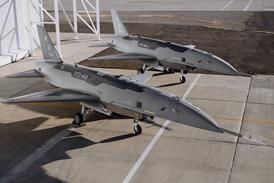











Boeing is proposing the F-15EX as an effective command and control platform for collaborative combat aircraft (CCAs), particularly the MQ-28 Ghost Bat in development in Australia.
In a presentation at the Dubai air show, Boeing executive Brian Hartwig observed that the F-15EX’s rear seat features a large area display, making it useful for managing CCAs – particularly when autonomy is still in its early days.

“We think that the future fight is really going to be about managing information,” says Hartwig, a former US Navy fighter pilot.
“Yes, you have to be lethal, you have to be survivable… but the pilots and crews of tomorrow are going to have so much information that they have to manage, especially when we throw in MQ-28s and other CCAs in the future.”
To make CCAs effective, it is critical that they do not become a management burden for the pilots of manned aircraft. Having an F-15EX backseater managing CCAs helps spread this workload.
The concept of an onboard CCA coordinator is not new. The Chengdu J-20S adds a rear seat to the iconic Chinese stealth fighter; it is believed that the extra seat is for a crewmember to manage CCAs. It is also believed that the second crewmember in the developmental Chinese aircraft loosely designated J-36 will be tasked with managing CCAs.
In a Boeing video rendering of future air warfare, an F-15EX crewmember uses menus to assign tasks and rules of engagement to a series of MQ-28s. The MQ-28s are not armed, but are tasked with exploring a threat environment and passing back information to the F-15EX.
“That’s really what we see as the future: using unmanned assets to push further downrange, reduce risk for the manned platform… while increasing lethality and survivability for the manned platform,” says Hartwig.

Hartwig says that the company is doing work in the lab to understand how manned aircraft and CCAs will one day work together, with an eye to ensuring that CCAs do not radically increase workloads for the crew aboard manned platforms.
Hartwig was speaking with a colleague, Garth Haselden of Boeing Defense Australia, which is developing the MQ-28 in cooperation with the Royal Australian Air Force.
Caselden stresses that the MQ-28 is designed to complement manned assets, employing various sensor capabilities in its swappable nose. He reiterated that the MQ-28 is working towards the launch of a Raytheon AIM-120 Advanced Medium-Range Air-to-Air Missile against an airborne target.