













Washington think tank concludes aerial resupply operation would require nearly all US strategic mobility assets while only providing basic humanitarian relief to Taiwan’s 23 million people.

Breaking a blockade of Taiwan via aerial resupply would require an effort so herculean as to be effectively implausible.

That is the conclusion of recent wargames conducted by the Washington-based Center for Strategic and International Studies (CSIS), which explored the various possible outcomes of a blockade scenario around Taiwan.

The blockade strategy first came into the public eye in 2022, after Beijing launched an aggressive series of air, missile and naval drills in response to an official visit to Taipei by then-speaker of the US House of Representatives Nancy Pelosi.

Three years later, the CSIS has released a wargame examining how a Chinese military blockade of Taiwan might play out, and what options Washington might have to break it.

Keeping the island nation resupplied via air would represent a huge logistical challenge for the Pentagon, according to the CSIS, requiring upwards of 860 sorties per day by large cargo aircraft.

That calculation is based on a maximum 36t loadout for a Boeing C-17 strategic transport and a Taiwanese population of over 23 million people, requiring some 39,000t of supplies per day.

That materiel would come primarily in the form of energy products and food, but also spare parts and emergency medical supplies.

“If the United States made a massive effort on an airlift, it could keep the Taiwanese people alive and supplied with the very basics of life but the economy would collapse,” says Mark Cancian, the study’s lead author and a retired US Marine Corps officer.

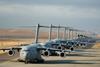
USAF C17s

Source: US Air Force

Delivering the sheer tonnage of supplies needed to sustain Taiwan’s 23 million people and modern industrial economy via air would require an unprecedented mobilisation of resources, including all of the USA’s strategic airlift assets

Released on 31 July, the results of the CSIS wargame paint a grim picture for both sides in a blockade scenario, with thousands of casualties and hundreds of ships and aircraft lost by both China and the USA.

Much of those losses depend upon how aggressively Beijing seeks to enforce its quarantine of the island and how much force Washington is willing to employ – and how many losses it is ready to endure.

Breaking a blockade via airlift is only remotely plausible if Beijing chooses not to engage US and allied aircraft entering Taiwanese airspace.

The study’s authors note this condition is what allowed the US-led Berlin Airlift to succeed in 1948, after the Soviet Union declared a land blockade of allied-controlled West Berlin.

“Soviet aircraft harassed allied cargo aircraft but backed off after some crashes and casualties,” the CSIS authors note. “A US airlift into Taiwan would pose a similar dilemma to China – shoot down aircraft with humanitarian supplies and take worldwide criticism or allow the flights, hoping that they would not alter the outcome of the blockade.”

If Beijing chose to bring its air force to bear, such an airlift effort would quickly become impossible.

But even if mainland China allowed relief aircraft into Taiwan, the challenge of resupplying the island would still be orders of magnitude more difficult than in Berlin.

At the peak of that effort in 1949, daily cargo flights reached 924 sorties, with an overall average of 680 flights per day throughout the 15-month airlift.

Taiwan has a population roughly eight times that of post-war West Berlin, with a substantially higher need for energy products like liquefied natural gas, which cannot be transported by air.

Flight routes into Taiwan from friendly bases in Japan, Guam, South Korea and Australia are also significantly longer than the distances between Berlin and Western Europe. This will reduce sortie generation.

A hypothetical Taiwan airlift would entail routes ranging from 355nm (657km) to 1,470nm – compared to only 234nm in Berlin.

“An airlift does not represent a long-term solution,” the CSIS scholars conclude. “It would require nearly all US strategic mobility assets, greatly reducing the United States’ ability to respond to other global crises.”

Even with a full commitment of resources, the authors conclude that the Taiwanese economy would see electricity generation fall to roughly 20% of pre-blockade levels, precipitating an economic collapse.

While the study concludes that only a large-scale maritime resupply effort could save Taiwan from a protracted blockade, the authors note that an airlift of a more limited duration could create space for diplomats to reach a negotiated settlement.

C-17 mass takeoff

Source: US Air Force

The US Air Force will need a large portion of its strategic lift assets to support the movement of US forces and materiel into the Indo-Pacific region, limiting the number that would be available to assist Taiwan with resupply

There is also significant doubt as to whether China could effectively enforce a blockade, particularly if the USA commits to forcibly opening passages to Tawain.

“This is a high-risk proposition for China,” says Eric Heginbotham, one of the study’s authors. “This not an easy lift for them.”

Of particular note is how a blockade might fit into Beijing’s overall strategic plans.

Such a move has typically been considered as either a shaping operation ahead of a full-scale invasion of Taiwan or as a lower-risk alternative that does not fully commit Beijing’s military forces.

However, Heginbotham now concludes that Beijing likely only has the resources to carry out one operation or the other – a full invasion or a blockade – and the losses taken during either would leave China’s forces too depleted to subsequently undertake the alternative course of action.

“In either scenario, China is going to lose assets it needs for the other option,” Heginbotham says. “Moving from one to the other is probably not going to happen.”

He notes that a blockade that transitions into a full-scale invasion would also eliminate the element of surprise for Beijing, affording Taiwan and its allies crucial days and weeks needed to reposition forces and supplies needed to fend off a cross-strait incursion.

Despite the impracticality of breaking a blockade via airlift, the CSIS report still recommends the Pentagon have plans in place for doing so, as such a contingency could still offer much needed humanitarian relief to the island, albeit limited and temporary.

Any such effort would require the support of multiple regional partners, including diplomatic permission to use their air bases and civil airports for resupply flights to Taiwan – an outcome against which Beijing is sure to deploy coercion methods.

“The scale of such an airlift would be unprecedented in recent history,” the report notes. “Nevertheless, in some circumstances, an airlift could have a powerful moral effect and provide some breathing room.”