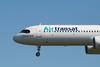













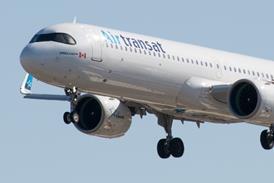
Canadian leisure carrier Air Transat now expects to start taking deliveries of Airbus A321XLRs in 2027.
The Montreal-headquartered carrier revealed the later-than-expected delivery schedule in disclosures to investors this week.
Transat placed long-term lease orders for four A321XLRs through an agreement with Air Lease Corporation in September 2022. At that point, the long-range narrowbodies were expected to be delivered at the end of this year and into 2026.
Now, it expects no new aircraft deliveries through the end of next year.
American Airlines recently became the first North American operator of the type, with its first premium-equipped A321XLR debuting on flights from New York to Los Angeles.
Earlier this year, Air Canada said its first delivery of the extra-long-range variant of the A321neo – marketed by Airbus as a “game changer” – would be delayed ”by a few months, with the first aircraft now due to be delivered in 2026”. United Airlines also pushed back its projected first delivery of the type into next summer.
But Transat had remained quiet on the subject of A321XLR deliveries until this week. Its annual report to investors shows that it expects to take four of the jets in 2027 and 2028.

Transat also shares a more-optimistic outlook for its persistent engine availability issues, which finally show signs of easing.
Throughout the past 12 months, the airline averaged between six and eight grounded Airbus A321LRs due to Pratt & Whitney’s geared turbofan (GTF) recall, according to chief executive Annick Guerard.
That represents a significant percentage of the carrier’s fleet of 19 Airbus narrowbodies, and its overall fleet of 44 aircraft.
“Conditions began improving towards year-end, and we closed the [fiscal] fourth quarter with four grounded aircraft,” Guerard said during the company’s 18 December earnings call.
”The situation is expected to keep improving with the number of grounded aircraft projected to range between and five during 2026.”
A “full resolution” to Transat’s GTF-related aircraft groundings is expected by the end of 2027 or beginning of the following year, Guerard says.
That roughly aligns with the expectations of other airlines hindered by the engine recall, which began in July 2023 in response to potential manufacturing defects. Taking the latest-generation turbofans off-wing for inspections and repairs has proven massively disruptive for global operators of A320neo-family aircraft. A220s and Embraer E195-E2s are also affected by GTF engine woes.
Some airlines have reported engine shop turnaround times exceeding 300 days.
US leisure carrier JetBlue Airways says it will return to a growth trajectory next year as it finally expects a reduction in its average number of grounded A320neos and A321neos.
Like Transat, Mexican low-cost carrier Volaris expects to be working through the GTF recall through at least 2027 and likely into 2028.
Transat has been strained by the years-long recall, though it has secured compensation packages from P&W to cover some costs related to the grounded jets.
“Despite the damaging impact of this persisting issue, we have been able to improve our overall performance in 2025,” Guerard says.
Parent company Transat AT reports a loss of C$12 million (C$8.7 million) during its fiscal fourth quarter, which covers the August-October period. That compares with a C$41 million gain during the equivalent period of 2024.
The airline company has struggled to be profitable for years, even before the Covid-19 pandemic. Airline Business data show that it has recorded net losses in 20 of the past 24 fiscal quarters.
Guerard says that the A321LRs returning to service will boost Transat’s financial results in the months ahead.
”We are reducing significantly the number of AOG [aircraft on ground],” she says. “The A321LR is our most-efficient aircraft, which drives margins up.”
Transat also anticipates receiving a performance boost from its incoming A321XLRs, which have a range of 4,695nm (8,700km).
”Along with the A321LR aircraft, the A321XLRs figure as a cornerstone of Transat’s 2022-2026 strategic plan since they make it possible to serve Air Transat’s destination network for the entire year,” the airline says in its annual report.
”These aircraft will also allow optimised aircraft rotations, combining short flights between two rotations to Europe (up to 17 hours of flight per day).”