












The lighter side of Flight International.
Down Under in days
Australia used to be a long way… a very long way from Europe. Even in the second half of the 20th century, a voyage by ocean liner took at least three weeks and popping back to the mother country was not really an option for emigrants.
However, even before the Second World War, the superjumbos of that era were beginning to conquer Australia’s tyranny of distance, as a book to which former Qantas chief executive Alan Joyce contributes the introduction describes.
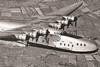
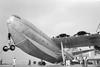
Sydney Seaplanes: Honouring Heritage, Embracing the Future, looks at the development of Rose Bay on Sydney waterfront as Qantas’s first international airport during the flying boat era. The UK-Australia route was operated by Qantas Empire Airways, a partnership between the flag-carrier and Imperial Airways to deliver mail and passengers on Short Sunderland and Consolidated Aircraft Catalina amphibious airliners.
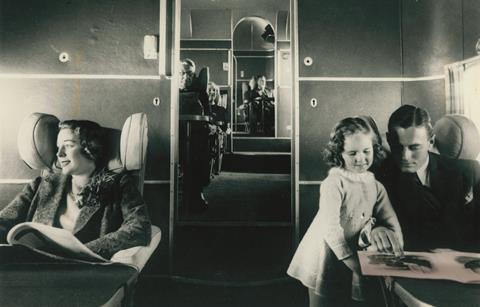
Way before lie-flat business class, these types offered bunk beds and considerable comfort during the roughly 60h, multi-stop journey.
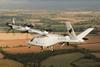
While the last proper seaplane departed from Rose Bay in 1974, Sydney Seaplanes still flies amphibious services from there, taking tourists on sightseeing flights and to restaurants and attractions around the Sydney coastline using a fleet of Cessna Caravans and de Havilland Canada DHC-2 Beavers. Its founder Jerry Schwartz co-launched the book with Joyce and author Carolen Barripp.
Meanwhile, Qantas will next year introduce its ‘Project Sunrise’ direct flights on Airbus A350-1000s, reducing the flight time between London and Sydney to a third of what it was in the flying boat days.
Copies can be ordered from reservations@seaplanes.com.au (A$20/$13).
Falklands veteran
A remarkable relic of the Falklands War is on display at Doncaster’s South Yorkshire Aircraft Museum as part of its “11 Weeks in 1982” commemoration of the South Atlantic conflict.
The Fabrica Militar de Aviones (FAdeA) IA-58 Pucara light attack aircraft ‘A-515’ took part in several sorties against British forces until being damaged by small arms fire and finally handed over following Argentinian surrender on 14 June.
Returned to the UK for evaluation at the Aircraft and Armament Experimental Establishment at MoD Boscombe Down, the turboprop was flown for around 25h in the UK, the only captured Pucara to do so. Following the trials, it was transferred to the RAF Museum in Cosford and remained there for over 40 years before being transferred to its current home late last year.
FAdeA produced some 107 Pucaras between 1974 and 1999, and though the Turbomeca Astazou-powered type is now retired from its light attack role, Buenos Aires has a retrofit programme to convert a number into intelligence, surveillance and reconnaissance variants, dubbed the IA-58 Fenix.
Nuuk threat
Donald Trump’s belligerent insistence that Greenland becomes a US territory – and refusal to rule out military force to achieve it – has not stopped his administration recently approving arms sales to Denmark, whose kingdom the Arctic island is part of.
In November, Washington cleared the sale of hundreds of Raytheon AIM-9X Sidewinders to Copenhagen, followed by three Boeing P-8A maritime patrol aircraft, and 100 Hellfire missiles.
Let us hope they never get used in anger in a NATO civil war.
Electric dream
Part of electric aviation history – yours for just $500.
Spotted on Facebook Marketplace, the front fuselage of an original Eviation Alice prototype (this example never flew, although a much-tweaked variant did take to the air in 2022).
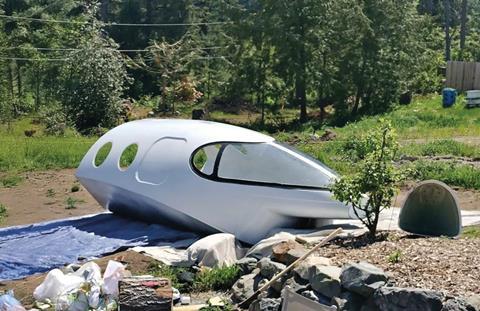
According to the vendor, the structure would “make a cool kids playset or a flight simulator”. Any buyer must haul it away themselves, and, as the seller admits, it needs a “touch-up paint job”, although “I have a gallon of industrial paint that will go with it”.
After announcing a flurry of orders in 2023 and 2024, Washington State-based Eviation is in what is euphemistically termed a dormant state. In February last year, it announced that it was laying off most of its staff as it sought “long-term partnerships” to bring the nine-seat, all-electric Alice to market.
From yuckspeak to tales of yore, send your offcuts to murdo.morrison@flightglobal.com