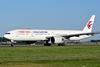













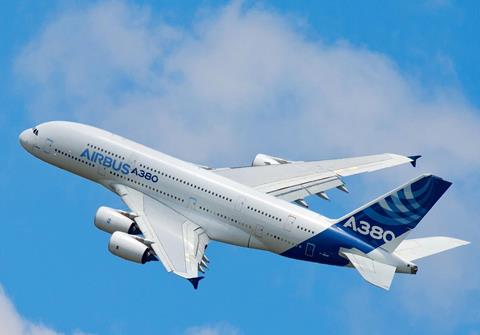
Airbus has developed a flight-computer software update for A380s after a training flight incident in which two engines received an erroneous thrust roll-back command just after take-off.
The incident involved a “concurrent” thrust reduction to idle after lift-off, says the European Union Aviation Safety Agency.
It has not identified the airframe, the engine positions affected, or the date and location of the occurrence.
But EASA states that the crew had moved the thrust levers from their take-off setting to the climb detent below the thrust-reduction altitude – the height at which climb thrust would normally be engaged.
Analysis found that the primary flight-control and guidance unit generated an “erroneous” soft go-around command with a “valid and reliable” thrust target.
Soft go-around is a function which computes a thrust target – lower than take-off power – to meet go-around performance requirements based on weight, configuration, environmental parameters and other data.
Airbus says the function is a “significant safety and operational improvement” which eases go-around handling for the crew by reducing the high acceleration forces associated with the manoeuvre.
The airframer has issued a service bulletin, dated 9 July, covering a software update to the primary flight-control and guidance unit, intended to prevent cases of uncommanded thrust reduction during soft go-around.
EASA is proposing to mandate the upgrade, which applies to Rolls-Royce Trent 900-powered A380s, with operators required to carry out the work on each affected unit within nine months.