














US investigators found fatigue cracks on pylon-mount components retrieved from the wreckage of the UPS Boeing MD-11 Freighter that crashed near Louisville on 4 November, killing 14 people, according to a preliminary accident report.
Released by the National Transportation Safety Board (NTSB) on 20 November, the report describes the incident as “similar” to the May 1979 crash of an American Airlines DC-10 that killed 273 people.
The report does not draw conclusions about why the UPS jet’s pylon-mount components had suffered fatigue cracks.
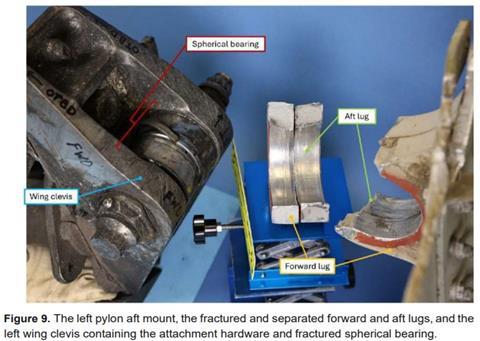
“The left pylon aft mount’s forward and aft lugs were both found fractured,” says the NTSB. “After initial cleaning of the fracture surfaces, examination of the left pylon aft mount lug fractures found evidence of fatigue cracks in addition to areas of overstress failure.”
A FlightGlobal report on 10 November said investigators were focused on the aft engine mount, but the NTSB’s report makes clear the aft pylon mount is the assembly under scrutiny. The engine connects to the pylon and the pylon connects to the wing.
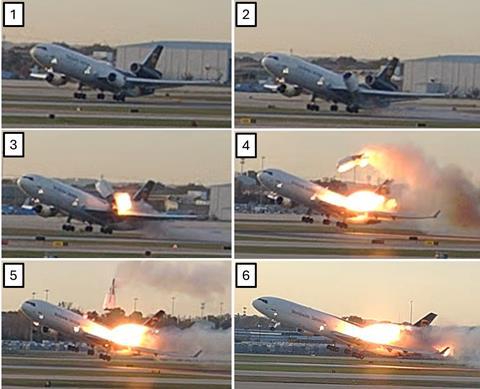
While taking off from Louisville Muhammad Ali International airport, the jet’s left-side GE Aerospace CF6 turbofan and pylon separated from the wing, travelled over the aircraft and landed near the runway. The separation involved a fire that engulfed the MD-11F’s left wing. The aircraft, registration N259UP, was operating UPS flight 2976 to Honolulu.
The Federal Aviation Administration on 8 November ordered MD-11s and DC-10s, a predecessor type, grounded.
The jet ascended to only about 30ft before rolling left and crashing into buildings beyond the end of the runway, killing all three pilots aboard and 11 people on the ground. Another 23 people were injured.
Each of the MD-11F’s pylons are connected to the underside of the wing by two mount assemblies – one forward, one aft – and a thrust-link assembly, the NTSB says.
Both of two lugs in the left pylon’s aft mount showed evidence of fatigue cracks, and both lugs fractured during the incident. Some mount components were found near the runway and others were found at the main crash site.
The MD-11F had undergone maintenance on 18 October that included “lubrication tasks” to “pylon thrust links and pylon spherical bearings”, says the NTSB. Those bearings are part of the mount assemblies. In October 2021, the aircraft underwent maintenance that included visual inspections of the left-side pylon aft mount.
The MD-11F had logged 21,043 cycles (and 92,992h) at the time of the crash. It was to undergo detailed mount inspections of different components when reaching 28,000 cycles and 29,200 cycles.
The NTSB calls attention to the 1979 crash of an American Airlines DC-10.
The American jet’s left-side CF6 and pylon detached during take-off from Chicago, causing the aircraft to roll left and crash.
Investigators attributed the accident partly to improper maintenance procedures that damaged mounting components, leading them to fail. But investigators said a more-central factor was an asymmetrical stall induced by uncommanded retracting of the jet’s left-wing slats, due to the engine separation.
”We appreciate the National Transportation Safety Board’s prompt release of preliminary findings and will fully support the investigation through its conclusion,” says UPS. ”We continue to grieve for the lives lost in the tragic accident.”
Boeing says it will ”continue to support the investigation led by the NTSB. Our deepest condolences go out to the families who lost loved ones and our thoughts remain with all those affected”.