













German investigators have disclosed that an Air Atlanta Icelandic Boeing 747-400 freighter captain entered an incorrect rotation speed into the flight-management system, before the aircraft sustained a tail-strike on take-off from Frankfurt Hahn.
The speed entry of 141kt was 30kt below the correct figure of 171kt which the pilots had calculated beforehand.
According to investigation authority BFU, which has newly published its findings, the first officer testified that he did not notice the incorrect input while the aircraft was parked or during the subsequent taxi and take-off roll.
The 747 was bound for Greenville-Spartanburg, South Carolina, on 29 November 2023.
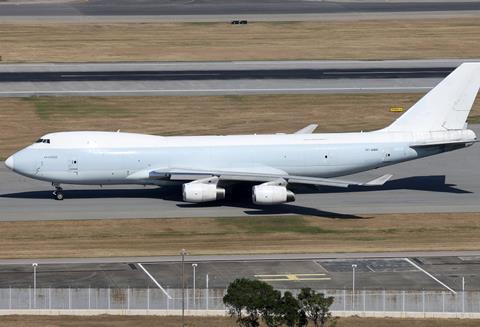
Accelerating along Hahn’s runway 21, the aircraft began rotating at 150kt and lifted off at 167kt after travelling about 2,100m.
But almost immediately after the jet became airborne and pitched 15° nose-up, its stall warning and stick-shaker activated, and its tail contacted the runway.
The captain, who was flying, pushed the control yoke forward to lower the nose.
BFU says the stall warning and stick-shaker ceased after about 4s and the jet accelerated to climb speed.
The crew proceeded to continue the transatlantic flight, it adds, because they “did not notice” the tail-strike during rotation.
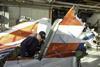
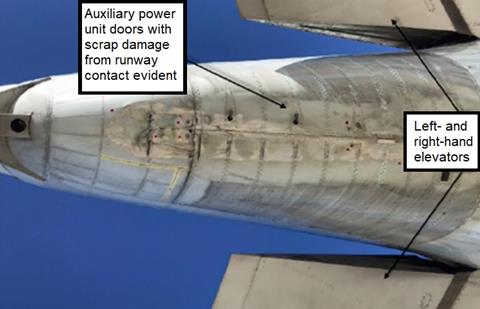
Examination of the 747 after arrival at its US destination revealed damage to the auxiliary power unit maintenance doors, behind the unit’s firewall.
“There was no damage to the main structural elements in the aft section of the aircraft,” says BFU, and the safe operation of the jet was not jeopardised.
The inquiry did not have access to flight-data recorder or cockpit-voice recorder data, owing to delayed reporting of the incident, and relied instead on quick-access recorder information and crew testimony.
But its analysis points out that speed values from 100kt to 300kt can be entered in the open fields on the flight-management system, and the software “does not check the plausibility” of the figures.
The crew did not crosscheck the entered data, it adds, and the error went undetected.
Air Atlanta Icelandic has since implemented several safety measures, emphasising adherence to procedures – especially crosschecking – during data entry.
Given that the crew was behind schedule, owing to a late pick-up, the carrier has also increased check-in time for crews to reduce pressure on preparation for flight.
It has clarified maximum permitted flight-duty periods, to reduce confusion, and adapted crewing policies to require an additional pilot on flight where such periods exceed 8h, to reduce stress and potential fatigue.