













US transportation secretary Sean Duffy will soon meet with President Donald Trump to discuss selecting a contractor to oversee the Federal Aviation Administration’s planned air traffic control (ATC) modernisation.
Duffy made clear on 19 November his intention for president Trump to have a say in the selection, noting Trump himself proposed the idea of hiring a single company to lead the ambitious project.
Meanwhile, aware of the FAA’s past struggles with technology updates, lawmakers are urging caution before throwing more money at the effort.
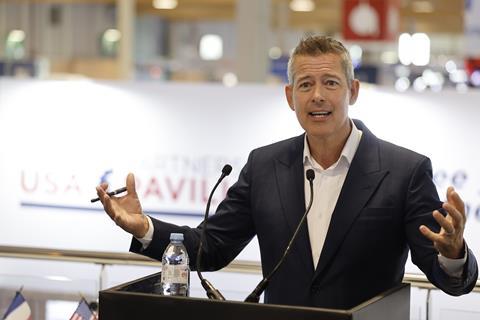
“I want the president to be involved in the selection,” Duffy says of the DOT’s pending selection of the project’s single “integrator” – the firm charged with managing the entire project.
He seeks “feedback” from Trump and says the DOT’s selection is “weeks away”.
Trump threw his support behind ATC modernisation after an Army helicopter collided midair with a passenger jet near Washington, DC in January. Beyond that, the FAA’s decades-old systems have suffered numerous disruptive failures in recent years.
Trump’s modernisation effort already received $12.5 billion under the One Big Beautiful Bill that became law in July. Congress earmarked that money for an initial phase involving new telecommunications equipment and radars, and facilities updates.
Duffy needs another $19 billion to meet the project’s $31.5 billion estimated bill.
The FAA in August began accepting applications for the lead integrator. Documents say the second phase involves “comprehensive reinvention of” ATC systems under a “common automation platform”, with a 3.5-year completion timeline.
The FAA is unprepared to implement such a sweeping, fast-paced plan on its own, Duffy says.
“No offence to those at the FAA,” he adds. “The FAA does a great job on safety, but they’re not builders. This is not what they do.”
The FAA is not known for effectively managing enterprise-wide modernisations, having been repeatedly criticised for delays and failures associated with its previous such effort, called NextGen.
That experience leaves some lawmakers cautious about approving more funding for Trump’s project.
“I am not just going to throw another $20 billion in their direction if we can’t hold them accountable for the” already allocated $12.5 billion, Republican congressman and House aviation subcommittee chair Troy Nehls said on 19 November. ”We are going to have to have some metrics… and very positive results.”