

















Czech advanced air mobility developer Zuri has revealed more details of its scaled second-generation technology demonstrator – referred to as TD2.0 – including significant changes to the aircraft’s V-tail configuration.
Due to fly in late 2026 or early 2027, the hybrid-electric vertical take-off and landing (VTOL) demonstrator is designed to validate the technologies which form the core of the company’s future commercial product: a VTOL aircraft capable of carrying four passengers and a single pilot.
Technologies to be evaluated include the hybrid-electric powertrain – the turbogenerator, batteries and electric motors – tiltrotor mechanism, and the aircraft’s control laws.
“TD2.0 incorporates lessons from years of simulation, subscale testing, and full-scale experimentation,” says Zuri.
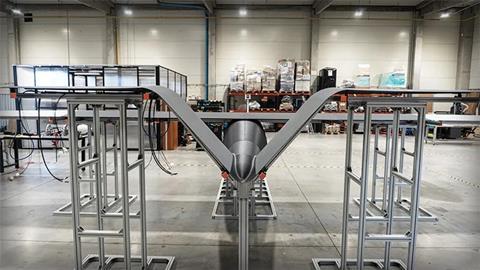
Critically, it also features a redesigned tail section, moving from the standard V-tail shape seen on earlier iterations to a flattened V design featuring horizontal surfaces capped by vertical fins.
Zuri says the change is to “improve aerodynamic stability and reduce drag in forward flight”. Based on the outcome of the tests it will decide whether to incorporate the new configuration onto the future five-seater.
Weighing around 700kg (1,540lb), versus 2,800kg for the eventual production aircraft, the uncrewed demonstrator will be capable of flying at 108kt (200km/h) with a range of up to 135nm (250km), against respective figures of 190kt and 378nm for the future model.
It also uses an all-metal construction rather than the composite structure planned for the production aircraft.
Additionally, it will have a 9.7m (31.8ft) wingspan – smaller than the 11m span on a preceding technology demonstrator – and use eight three-blade fixed-pitch rotor blades, rather than the five-blade, variable-pitch rotors intended for the production aircraft.
In both cases, the front rotors are larger than those at the rear. On the demonstrator, this means rotor diameters of 1.44m and 1.36m.
Various flight modes have already been “demonstrated extensively in more than 10 subscale models” says Zuri, with the new technology demonstrator to “validate them at full scale through unmanned testing”.
Meanwhile, Zuri is continuing to develop its ‘iron bird’ ground-test rig, which will be used to validate the aircraft’s hybrid-electric powertrain.
Zuri was recently bolstered by an agreement with Ambitious Air Mobility Group that will see the Dutch firm invest as part of its Series A funding round.