













Several Chinese carriers have formally lodged objections to a proposed ban on using Russian airspace for US services, while major US operators have – equally predictably – shown support for the measure, and urged an even broader response.
The US Department of Transportation detailed its proposal on 9 October, sparking high-level concern over the
China’s foreign ministry spokesman, Guo Jiakun, stated shortly afterwards that US restrictions on Chinese airline operations would be “detrimental”.
“We suggest the US reflect on the impact of its own policies on domestic businesses, rather than unreasonably suppressing other countries and leaving global consumers footing the bill,” he remarked.
Air China claims the proposal – intended to take effect 30 days after a final order – is “contrary to public interest”, particularly given the number of passengers already booked to travel over November-December, and is seeking a minimum 60-day grace period.
China Southern Airlines has expressed similar concerns over the inconvenience the rule will impose peak holiday travellers – including both Chinese and American passengers.
“If adopted, the [Department of Transportation’s] proposal will lead to increased disruption in the US-China passenger market which is already subject to lowered frequency limitations,” it states.
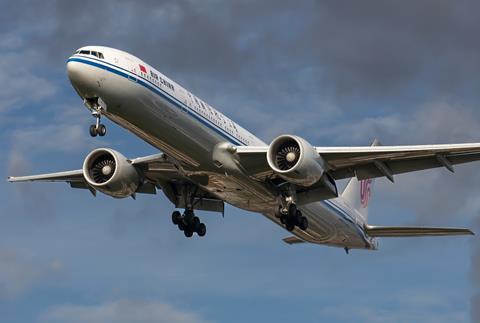
China Eastern Airlines argues that the proposal “fails to protect passenger rights”, because it will force an extension of 2-3h on flight duration on some of the carrier’s most important routes – particularly the “already lengthy” transpacific sectors.
“It would significantly increase passenger fatigue and discomfort,” it adds, as well as raising fuel consumption.
China Eastern also argues that the US-China bilateral agreement has a specific dispute-resolution clause, intended to allow negotiations, but says the US side has “acted unilaterally” and ignored the mechanism.
The carrier says it has “always cherished its long-term co-operation” with the USA and is looking to “explore constructive, balanced and pragmatic solutions”.
If the proposal goes ahead, the adoption of “non-optimal” flightpaths will increase operational complexity over the winter season, increasing workload for crews, claims Sichuan Airlines.
“Given that safety is our unwavering priority, we must express deep concern regarding any policy that presents potential risks in this area,” it adds.
Similar points have been raised by Hainan Airlines and Xiamen Airlines in separate submissions to the Department of Transportation.
But major US carriers are backing the plan. United Airlines says it is “effectively barred” from resuming nonstop Chinese routes from New York, Newark, Washington and Chicago.
“The competitive harm to US airlines has been substantial and multifaceted,” it states.
While United describes the proposal as “another important step” towards restoring “long-needed competitive balance”, it also believes carriers in Hong Kong should be covered by the measure.
“Allowing different treatment for Hong Kong, where competitive circumstances are the same as China, would undermine the success of the framework the Department continues to manage to ensure fairness in US-China routes,” the carrier says.
United says Hong Kong-based airlines have a 75% seat share in services from Hong Kong to the US mainland, and is taking particular aim at Cathay Pacific. Transit though Hong Kong is a “loophole that needs to be closed”, the US airline claims.
While Delta Air Lines “commends” the US proposal which, it says, will “help ensure a more level playing field” between US and Chinese airlines, it points out that Chinese carriers are not the only ones taking advantage of Russian airspace access.
“The Department should also consider the use of Russian airspace to serve the US by carriers of other countries who are similarly enjoying an unfair competitive advantage,” it says.
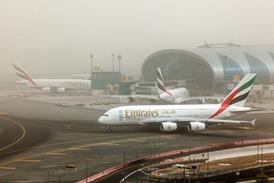
Delta does not identify these other operators, but ADS-B flight data indicates that airlines including Emirates and Air India have recently crossed Russian airspace en route to San Francisco or Chicago.
US-based operator National Airlines also believes the proposed ban go further, and be extended to all-cargo carriers.
It says the exclusion of Chinese all-cargo airlines from an “otherwise commendable” decision is a “glaring omission” which has “significant competitive consequences” for US cargo carriers.
“Inability to overfly Russia hinders all of National’s cargo operations to and from China and the Southeast Asia region but is especially problematic for services continuing on to, or originating in, Europe,” says the airline.
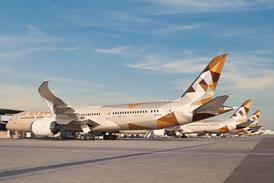
National adds that other foreign all-cargo operators – including Emirates, Etihad Airways and Qatar Airways – also have this advantage.
According to the Department of Transportation’s proposal, the nature of the US-China competitive field for all-cargo services is “distinctly different” from that for combination services. It claims the “far more liberal” route rights in the US-China bilateral justifies its decision not to include Chinese all-cargo operators in its ban.
But National is nevertheless urging the Department to “follow through on the logic of its decision” by prohibiting all foreign cargo operators from using Russian airspace to serve US routes, describing the protection of some US carriers but not others as “arbitrary and capricious”.