












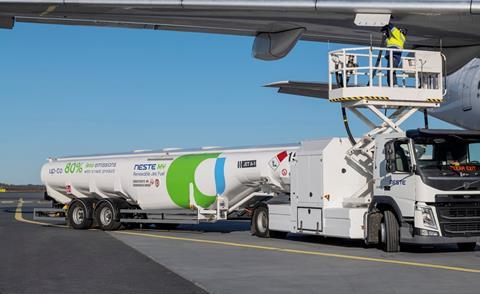
Singapore expects to centrally purchase its first batch of sustainable aviation fuels (SAF) in 2026, as part of its uplift target of 1% SAF within the same year.
This follows the launch of Singapore Sustainable Aviation Fuel Company (SAFCo), a government-owned non-profit company that will oversee the acquisition and distribution of SAF, as well as implementation of the country’s SAF policies.
To fund the procurement of SAF, the Civil Aviation Authority of Singapore (CAAS) will also be implementing a SAF levy on all departing travellers from 2026. The levy, first announced in 2024, will also cover cargo flights, as well as business and general aviation passengers.
CAAS says details of the levy – including its quantum and roll-out date – will be announced later. It is expected the levy will be rolled out first before SAFCo begins procuring SAF.
The agency gave examples in 2024 on how much the levy could cost: an economy-class passenger flying to Bangkok could pay S$3 ($2.31), while those flying to London could pay S$16.
The funds collected will be managed by CAAS, then disbursed to SAFCo, which will source the SAF “through a transparent competitive tender process…that meet international sustainability standards like CORSIA”.
CAAS director general Han Kok Juan, who speaking at a briefing on 30 October, says the “centralised pool” of funds means there is “predictable cash flow”, which allows SAFCo to “go into longer-term competitive price agreements to secure a more stable and more affordable SAF supply”.
On top of the mandatory levy, SAFCo will also roll out a scalable voluntary demand programme” for SAF and SAF Environmental Attributes. These will involve businesses and airlines looking to voluntarily purchase SAF, and CAAS confirms it is already in talks with a few businesses on the voluntary programme.
CAAS’ Han says Singapore supports SAF adoption through a “pragmatic and balanced approach calibrated to our own circumstances”.
For instance, the procurement of SAF will be done with a fixed-cost envelopment model, where the SAF levy – and the central funds – will be a fixed rate regardless of the price of SAF.
Adds Han: “It helps to encourage SAF production, to send clear demand signals while ensuring that costs remain contained, predictable and fairly shared. This, in turn, allows us to meet our environmental responsibilities while safeguarding the competitiveness of our air hub.”