









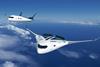

While Airbus expects its next narrowbody jet will have a traditional tube-and-wing configuration, it has not abandoned the idea of an eventual blended-wing-body (BWB) design for a larger jet.
That is according to the European aircraft manufacturer’s chief executive Guillaume Faury, who says Airbus believes long and thin wings mated to tubular fuselages are best suited for aircraft the size of the company’s A320neo family of jets.
“We looked at the blended-wing-body [and] we came to the conclusion that this is competitive for bigger planes,” Faury said on 9 September during the US Chamber of Commerce Global Aviation Summit in Washington, DC.

He notes that Airbus studied BWB designs as part of its ZEROe project – an effort launched in 2020 to evaluate possible development of a line of hydrogen-powered passenger aircraft.
One of those concepts was a 2,000nm (3,704km)-range BWB jet capable of carrying about 200 passengers. Airbus initially aimed for the ZEROe programme to result in an aircraft reaching market in the mid-2030s.
Earlier this year, however, Airbus slowed ZEROe, delaying the project by up to 10 years, saying neither hydrogen technology nor required infrastructure will be ready sooner.
Faury now says the thickness of a BWB’s wings are imperfect for smaller aircraft, citing drag.
“We have come to the conclusion that up to single aisles, we are better with longer wings,” Faury adds.
That aligns with concurrent work Airbus has done through its Wing of Tomorrow programme, under which it is evaluating longer, lighter and more slender wings for a next-generation single-aisle jet.
Several start-ups are also developing BWBs, including JetZero, which aims in 2030 to bring a 250-seat BWB to market.
The idea has high-profile supporters.
“It’s real,” United Airlines chief executive Scott Kirby said at the US Chamber event. “I think at some point in the future there’s going to be a lot of blended-wing-bodies flying around.”
Meanwhile, Faury has reiterated that Airbus aims at “the end of this decade” to launch development of its next narrowbody jet for service-entry in the second half of next decade.
Airbus targets a 20-25% fuel-efficient gain for that aircraft, with roughly half of the benefit derived from the engines and half from the design of the aircraft’s wings and fuselage, Faury says.
While Airbus has not committed to an engine for that future jet it expects the aircraft will have open-rotor engines derived from CFM International’s RISE demonstrator programme.
Lacking nacelles and other surrounding structures such as containment rings, open rotors generate less drag while allowing larger, and therefore more efficient, fans.
But without containment rings, engineers must find other means to keep components, in the case of engine failures, from damaging surrounding structures. Bolstering those structures with shielding is one solution, but doing so adds weight, eroding efficiency gains.
Faury concedes open-rotor designs come with “integration losses”. He is not more specific but insists that even with those predicted losses CFM’s open-fan engine should meet Airbus’s efficiency requirements.