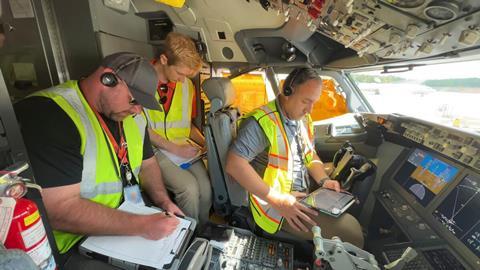



















Boeing recently completed its 2025 “ecoDemonstrator” technology-evaluation programme using a 737 Max 8 as a platform to test advanced internet-based communication technologies.
The company used the aircraft, provided by United Airlines, to “evaluate a modernised data communication system” using “internet protocol suite” standards and transmitted via satellite links, Boeing says.

“The internet-based communications aim to enhance operational efficiency and flight safety while reducing air traffic congestion, fuel use, cost and emissions,” the company adds.
It says such technology will replace legacy communications systems and are critical to enabling “trajectory based operations”, an air traffic management concept involving detailed flight-route planning for the purpose of ensuring aircraft fly more-direct routes, reducing delays and fuel burn.
Internet-based communications also provide tighter cybersecurity, Boeing says.
The programme involved nine flights piloted by United crew. Between 29 October and 2 November, the aircraft flew from Houston’s George Bush Intercontinental airport. It was then flown to Edinburgh in Scotland for additional flights on 6 and 7 November.
“The data collected from these flight tests will be used by the standards committees to enact changes for a technical framework and for future implementation,” Boeing says.
Boeing handled technology integration for the project. Collins Aerospace supplied connectivity and avionics software, Embry-Riddle Aeronautical University managed a Federal Aviation Administration contract covering the testing and Honeywell supplied prototype avionics software. The team used satellite-communications software from Thales, and Viasat’s communications services.