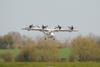
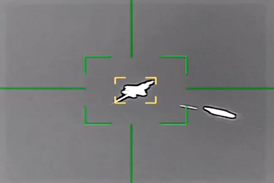















Shortly after daybreak at Embraer’s test facility in Gaviao Peixoto on 19 December, Eve Air Mobility executives and engineers watched as the engineering prototype of the start-up’s all-electric air taxi took flight for the first time.
Though brief, the roughly 30ft (10m) hover flight was a momentous occasion for Eve, which had been working toward the milestone since spinning off from Embraer in October 2020.
Johann Bordais, Eve’s chief executive, tells FlightGlobal that the team waited for the right conditions – no rain, minimal wind – which are by no means guaranteed during Brazil’s rainy season.
“Everything was just perfect,” he says. “We took out the engineering prototype, out onto the apron of the runway, and got the whole thing set up.”
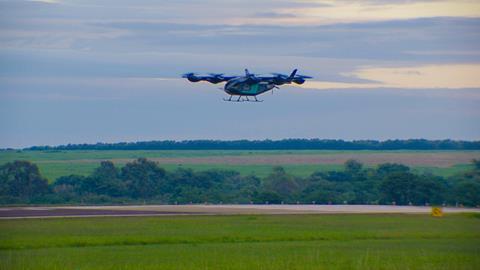
As the engineering prototype does not have an interior cabin, the hover flight was controlled from a remote pilot station, which Bordais says is “actually kind of weird for an Embraer test pilot; when they do this, usually you get in a plane”.
The test flight represented several first for Embraer, including the first flight of an all-carbon airframe, the first all-electric flight, and the airframer’s first-ever vertical flight.
“The fun one is the first flight where the departure time is the same as the arrival,” Bordais says.
The flight was “purely vertical”, with the team aiming to clear ground effect by rising to a height of about 30ft.
“We held it for 10 to 15s, and then we landed,” Bordais says. “That was the protocol and exactly what we agreed to with ANAC [National Civil Aviation Agency].”
While Eve has been viewed as trailing some US competitors in development progress – with Joby Aviation, in particular, conducting hundreds of test flights with its eVTOL aircraft – Eve may have closed part of the perceived gap by flying its prototype for the first time.
Bordais insists that Eve has been focused solely on its own product development pathway, and on hitting its own self-imposed milestones on time.
“We said that we would do it based on the expertise of Embraer,” he says. “We don’t look at the timelines of others. We look at what we need to do to certify a safe and reliable vehicle. We are on time with the schedule we gave ourselves and we gave to the market.”
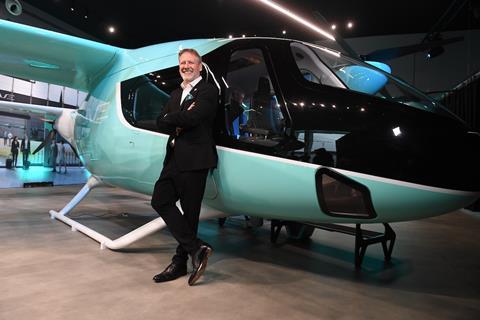
Over the next few months, Eve plans to conduct about 30 test flights that will gradually expand the flight envelope, building toward the all-important transition to wingborne flight. That is generally considered the mostly technically difficult achievement in an electric vertical take-off and landing (eVTOL) aircraft’s flight-test programme.
All told, the remotely piloted engineering prototype is expected to complete hundreds of flight-tests in support of Eve’s aircraft development.
Unlike competitors that have opted for tiltrotors to perform the transition, Eve’s design relies on eight vertical rotors and one aft-mounted pusher prop for forward flight.
The first flight of Eve’s air taxi delivered “what you want for the employees, the stakeholders, shareholders and customers”, Bordais says.
“Everyone that believed in us since the very beginning, five years ago when we created the company – and more recently when we did the IPO – is really shows how vigorous we are in execution,” he says. “Having a plan is one thing. Delivering the plan is obviously the most important part.”
Eve maintains its commercial plan remains on track. Next year, it plans to build six production-conforming air taxi prototypes – including on demonstrator – and to begin flight-testing with those prototypes in early 2027. Then will come a rapid progression: expected type certification from ANAC, followed by the first deliveries to customers and service-entry that year.
Crucially, Eve believes it has managed cash burn effectively, with a $240 million equity infusion earlier this year providing runway to support operations at least to 2027.
Building multiple prototypes to participate in flight-testing is “definitely based on the expertise of Embraer”, with Bordais pointing to the venerable airframer’s history of certifying commercial, business and military aircraft.
The production-conforming prototypes will be manufactured by Embraer and transported by truck to Gaviao Peixoto. There, Eve will have a hangar and vertiports at its disposal for a flight-test campaign observed by ANAC.
“Together with ANAC, we agreed that six prototypes is the right amount of vehicles to go through certification,” he says.
Eve claims the largest backlog of any air taxi developer, with more than 2,800 tentative orders on the books. It also secured its first firm order from Sao Paulo-based helicopter operator Revo during the Paris air show in June.
Revo is poised to become Eve’s launch customer in 2027.