














Another hybrid-electric aircraft developer came out of the shadows on 11 December with plans to build a 50-100 seater powered by a system composed of electric motors and Pratt & Whitney Canada (P&WC) PT6 turboprops.
Montreal firm Evio, founded by longtime aerospace veterans, aims to achieve first flight of its aircraft – the Evio 810 – in 2029, followed by early 2030s service entry. It counts P&WC and Boeing as collaborators.
“The complexities of the [hybrid] architecture is a little bit of our secret sauce and what gives us that competitive advantage,” says Evio chief executive Michael Derman.
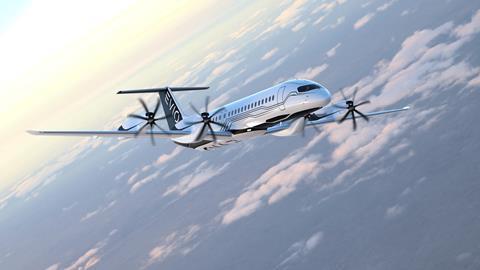
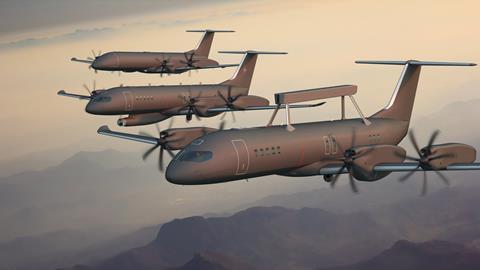
The 810 is to be a “strong” hybrid aircraft, meaning capable of operating shorter flights – perhaps of 100nm (185km) – using only battery power, including while taxiing.
Propulsion will come from a battery system and four wing-mounted units, each containing a PT6 mated to an electric motor. The turbines will be available to provide additional power for longer flights, acting as a “range extender”, Derman says.
“We have a design that really cuts back on the hours on the turbine”, minimising wear, tear and maintenance, he adds. “It’s not just that we’re attacking reduced fuel burn. We’re attacking reduced maintenance on those turbines.”
Evio has secured “conditional purchase agreements” covering the possible sale of 250 aircraft from two airlines, though it declines to say which. It holds options to sell another 200.
The 810 will be optimised for 200-300nm routes but capable of flying 500nm. Derman says the aircraft’s cabin will be wider than today’s regional jets, making it more comfortable for passengers.
Evio is among several players seeking to bring hybrid-electric regional aircraft to market. Others include start-ups Maeve Aerospace and Heart Aerospace, and ATR is developing a hybrid version of its turboprop.
Derman co-founded Evio with chief technology officer Luc Van Bavel last decade under the name Q Aerospace, then rebranded the firm Eos. But, thinking that name too generic, they have rebranding again to Evio, which “speaks to evolution”, Derman says.
The firm had until now remained “in the shadows”, with Derman saying, “We wanted to… show something that actually had some sincere engineering rigor behind it before coming out to the world”.
Evio has collaborated with P&WC to develop the 810’s propulsion system. Boeing has invested an undisclosed sum in Evio and provides guidance under a technical services agreement, Derman says.
“This collaboration is an exciting opportunity to advance the potential of novel hybrid-electric aircraft architectures,” says P&WC vice-president of sales and marketing Scott McElvaine.
Derman thinks new aircraft types, to be attractive to airlines, must be at least 8% cheaper to operate than existing types. “We are materially better than that…. We are coming in at a fraction of the operating cost,” he says.
Evio is also targeting cargo and defence (such as surveillance) applications for the 810, and Derman envisions the type acting as a power source to provide electricity to remote bases.
He is keenly aware long-term success requires more than just working technology. Airlines demand product support.
“We’re already starting to work on that aspect of the business to make sure that it’s not just a great aircraft design, it’s a robust business solution – the airplane, the service, the infrastructure required to support the whole operation,” he says.
Initially self-financed, Evio closed a first funding round 2023 and is working to close a second, though Derman declines to discuss figures.
He previously co-founded Angeles Composite Technologies and AirLand; the later partnered with Textron to develop the Scorpion light-attack jet. Derman also worked at Sierra Nevada, helping develop the Freedom jet trainer – an aircraft Evio co-founder Van Bavel helped design.
Evio’s board members include Rob Dewar, who led Bombardier’s design of the CSeries (now the Airbus A220), and former Lockheed Skunk Works vice-president Frank Cappuccio.
“There’s a lot of talent on our team that brings Q400, CRJ, CSeries experience,” Derman notes.
The 810’s roots go back about seven years to when Derman and Van Bavel initially considered demand for a new regional airliner.
They first studied smaller aircraft – 19- and 30-seaters. But realising airlines need aircraft to replace thousands of ageing ATRs and Dash 8s, they moved up-market. The 810’s design evolved over time.
Evio first considered equipping an existing aircraft type with “mild” hybrid-electric propulsion system – “mild” meaning the battery component provides boost power, supplementing turbines, during take-off and climb.
They could not make that configuration work.
“We couldn’t see how – with all the additional bill of material and still having the same size turbine – you could get to the economics that would really be disruptive,” Derman says. They also studied a clean-sheet mild-hybrid aircraft, but “still couldn’t get the operator economics to pencil”.
That led them to the 810’s “strong” hybrid-electric configuration.