











The US Federal Trade Commission (FTC) has approved Boeing to acquire aerostructures provider Spirit AeroSystems, while requiring divestitures of numerous Airbus-related operations that were already planned as part of the deal.
Boeing on 21 November signed off on the terms, according to documents the agency released on 3 December.
The FTC has opened its decision to a 30-day public-comment period but Boeing says it can close the acquisition before the comment period ends.

“The FTC decision does not delay Boeing’s planned merger closure. We can still close before the 30-day notice period,” the company says. “The divesture requirements were as expected.”
Boeing requires no other approvals and still expects to complete the acquisition before year-end.
“The FTC’s proposed order will protect competition in the large commercial and military aircraft markets, which are critical to American commercial travelers and national security,” the agency says.
“The divestitures resolve FTC allegations that Boeing’s acquisition of Spirit would give Boeing the ability and incentive to raise the cost or degrade Airbus’s access to inputs for its competing aircraft.”
Under the deal, Boeing must, within 10 days of closing the acquisition, divest to Airbus Spirit’s A220 pylon production line, the Airbus portion of Spirit’s Belfast (Northern Ireland) business, and Spirit operations in Kinston (North Carolina), St Nazaire (France), Morocco, and Prestwick (Scotland).
The FTC also requires Boeing to offload Spirit’s operation in Subang, Malaysia.
Airbus already agreed to acquire the assets, while Composite Technology Research Malaysia has agreed to take over the Subang site.
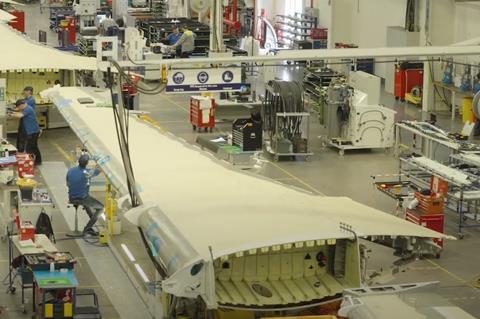
Spirit’s Prestwick facility produces A320neo and A350 wing components, while its Belfast site, formerly a Short Brothers plant, makes A220 wings and mid-fuselage sections and Bombardier business jet fuselage sections.
Boeing has said it will retain the non-Airbus portion of the Belfast facility.
Spirit manufacturers A350 fuselage sections in Kinston and St Nazaire, produces A321 and A220 components in Casablanca and makes A220 pylons in Wichita.
The Subang site provides components to Airbus and Boeing jets.
“We welcome the US Federal Trade Commission’s approval of our acquisition of Spirit AeroSystems,” Boeing says. “While the transaction has not yet fully closed, we are committed to completing the remaining steps necessary to finalise the acquisition.”
Boeing last year revealed its plan to acquire Wichita-based Spirit for $4.7 billion in stock, describing the move largely as a means to have better oversight of the supplier and better address Spirit’s longstanding operational and financial troubles.
For years, Spirit has struggled with quality problems and other issues that created major setbacks for Boeing.
Spirit produces 737 fuselages and aerostructures for Boeing’s other commercial and military aircraft. “This milestone will further enhance our ability to manufacture safe, high-quality airplanes for our customers and benefit the flying public,” Boeing says.