















The Trump administration has unveiled a plan backing the USA’s nascent advanced air mobility (AAM) sector, identifying 40 recommendations to “safely and efficiently” support the operations of air taxis and other in-development aircraft over the next decade.
The Advanced Air Mobility National Strategy was rolled out during a 17 December summit attended by executives of leading AAM companies and Transportation Secretary Sean Duffy in Washington, DC. It is described as a “bold policy vision” for ramping up electric vertical take-off and landing (eVTOL) operations over the next 10 years.
The plan follows Donald Trump’s executive order to “unleash American drone dominance”, issued in June, which established a framework for early air taxi operations through the eVTOL Integration Pilot Program.
It also builds on the Advanced Air Mobility Coordination and Leadership Act passed by the US Congress in 2022, and the establishment of a new “powered lift” aircraft category recognised by the Federal Aviation Administration under former president Joe Biden.
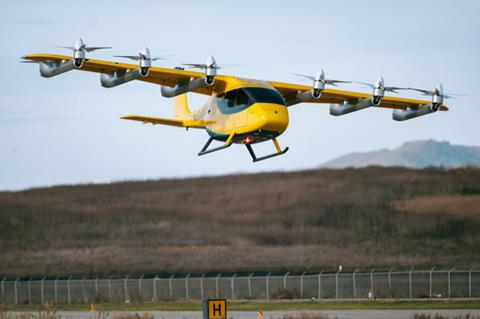
The 60-page document details six “pillars” on which to build the AAM industry, including airspace, infrastructure, security, community planning and engagement, workforce and automation. It outlines a vision for initial air taxi operations beginning in 2027, mostly using existing airport infrastructure.
”We will encourage a full US-based supply chain, encompassing automation technology companies with highly efficient avionics, advanced carbon component manufacturers and telecommunications providers, which could increase radio spectrum versatility,” it says.
That will be followed by more-robust operations by 2030, supported by vertiport infrastructure “funded mostly by private sources”. By 2035, the AAM industry will be exploring “exciting use cases”, including fully autonomous passenger-carrying flights.
”We envision a strong and lucrative job base with new and expanded career pathways in aviation,” the document states. ”We imagine fabricating cutting-edge passenger and cargo aircraft and their components in the United States and selling them to trading partners in a robust supply chain.”
The strategy has been broadly hailed by AAM companies in the USA, which include air taxi developers Archer Aviation, Beta Technologies, Eve Air Mobility, Joby Aviation and Wisk Aero, as well as hybrid-electric aircraft developer Electra and autonomous flight firm Reliable Robotics.
“Global leadership in advanced air mobility will be held by those who build, certify and deploy first,” says Kyle Clark, Beta’s founder and chief executive.
Duffy frames the AAM strategy in grandiose terms, noting that the announcement came on the 122nd anniversary of the the Wright brothers’ first flight at Kitty Hawk.
”It was their innovation, their creativity, how bold they were,” he says. ”They didn’t give up, and what they did 122 years ago fundamentally changed the world forever.”
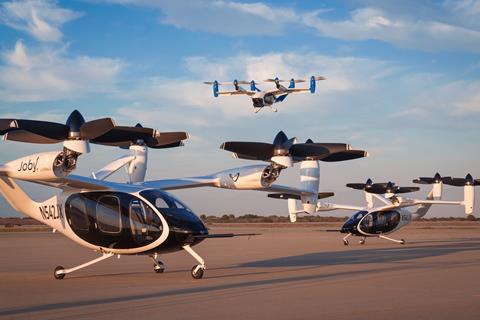
Now, the aviation landscape is shifting rapidly in the USA, with a number of companies advancing radical new electric aircraft designs.
”This technology, whether it’s an electric aircraft or an eVTOL aircraft, it has untold applications,” he says. “It is going to enhance emergency response and improve access for healthcare. It’s going to give us different regional mobility; where we live and where we work will fundamentally change with an eVTOL.”
Duffy also envisions “faster cargo operations and last-mile delivery”, as well as less-expensive aviation training in electric aircraft.
In the bigger picture, he suggests that developing new aviation technologies is critical as the USA tries to keep pace with China’s rapid technological development.
“America is not the only one that is innovating,” he says. “Some of our adversaries are chomping at our heels, or we’re chomping at their heels. The race is on. That adversary, for the most part, is China.”
Significant questions linger over the air taxi sector. Namely, the time- and cash-intensive FAA certification process has put intense pressure on eVTOL developers, which can can go only so long before generating revenue.