











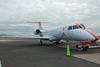

Start-up US regional carrier JSX intends early in 2026 to acquire two additional used ATR 42-600 turboprops, supplementing two of the type the Dallas carrier plans to begin flying this year.
JSX chief executive Alex Wilcox said on 17 September that the airline will use the four ATRs to gauge whether passengers view turboprops positively or as a step down from regional jets.
The airline, which has shaken up the US regional airline sector, expects to place the first two ATRs into service in October or November, and has “two coming in the first quarter of next year as well”, says Wilcox.

The carrier said in June during the Paris air show that it planned this year to start operating two ATR 42-600s to supplement its Embraer regional jets.
Wilcox now says that only after a trial period of flying the four turboprops and receiving customer feedback will JSX decide whether to move forward by placing firm orders for new ATRs.
“We have investors and we need to prove… that our customers are willing” to fly on turboprops, he tells FlightGlobal. “We don’t want to bet the company on this. We still need to prove it before we can put real money behind it.”
“We are going to know by March [2026],” he adds.
Due to fear of negative customer perception, the US regional airline industry has hesitated from returning to turboprops despite their efficiency and cost benefits.
Alongside its initial commitment at Paris, JSX said it had signed a letter of intent with ATR covering potential future orders for 15 turboprops and options for another ten. Those would be either ATR 42-600s with 30 “premium” seats or larger ATR 72-600s with 30 business-class seats, ATR said.
JSX will lease the first two ATR 42-600s from Dutch lessor TrueNoord, says the latter’s chief commercial officer Richard Jacobs. The ATRs were formerly operated by Florida’s Silver Airways, which shut down in June.
Wilcox says the first two aircraft are about three years old and that the second two are six years old.
JSX operates scheduled flights under Federal Aviation Administration Part 135 charter rules, which apply to carriers operating aircraft with 30 or fewer seats and which are generally less proscriptive than the Part 121 rules under which most US airlines operate. Part 121 airlines must fly to Part 139 airports, while charter carriers face no such requirement, opening them to many more airports. Also, Part 135 airlines are not subject to the 65-year pilot age cap mandated for Part 121 airlines.
The airline started flying about eight years ago. Its investors include JetBlue Airways, Qatar Airways, United Airlines and two “family offices”, says Wilcox.
The company’s fleet now consists of 49 in-service Embraer ERJ-135 and ERJ-145 regional jets, with an average age of 24 years, according to JSX. The aircraft have 30 seats each – far fewer than typical for the types, Cirium fleets data shows.

Falling under Part 135 rules lets JSX serve more airports than allowed for Part 121 airlines. Also, JSX passengers are not subject to the same security screening requirements, though Wilcox insists his company provides comparable security checks.
JSX has expanded significantly in recent years and now serves several dozen routes, many of them only seasonally.
It has overcome legal and regulatory challenges, including from behemoths like Southwest Airlines and American Airlines, which have urged the FAA to change its rules to prohibit scheduled airlines from flying under Part 135, saying the business model exploits a safety “loophole”.
“We are very confident and secure in our regulatory position,” Wilcox says.
The incoming ATRs will burn roughly half as much fuel as JSX’s ERJs and can operate from runways about half as long, opening many new airports to the airline, Wilcox says.
He expresses confidence customers will enjoy travelling on the ATRs and notes JSX has already had “tentative discussions” about securing access to a “certain percentage” of ATR’s production capacity.
Story updated on 18 September to include new JSX fleet details.