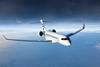














French business jet developer Beyond Aero has kicked off the hunt for a location for its future production centre, having completed feasibility studies for a facility sized to build up to 60 of its fuel cell-powered BYA-1s per year, a figure that could eventually rise to 120.
Currently headquartered in Toulouse in southwest France, near to the city’s Francazal airport, Beyond is now seeking a site for its proposed manufacturing campus, a facility that will include a 17,000sq m (183,000sq ft) final assembly line, delivery centre, customer showroom, paint shop, and research and development facilities.
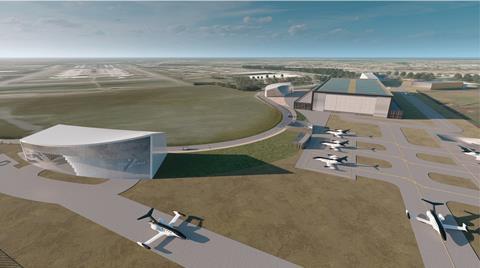
Beyond says it is “entering a structured evaluation phase to determine the future home of its industrial site”, with multiple locations vying for its attention.
“Several regions, including candidates in France and across Europe, have formally expressed interest, underscoring the growing strategic importance of hydrogen-electric aviation,” it says.
Beyond contracted Porsche Consulting and Kardham Group to carry out a feasibility study for the site, respectively examining the industrial architecture and its overall architectural design.
The analysis “clarifies the vision for a new aircraft manufacturing site”, it says, creating an “industrial foundation that strengthens regional economic development and advances a new era of aerospace innovation”.
Designed to support output of 60 aircraft per year initially, creating 225 production jobs, the factory has sufficient space to scale to 120 aircraft per year, if required.
“Modelling and testing our hydrogen-electric aircraft was only the first step. We are now building the industrial system capable of delivering it, integrating manufacturing requirements directly into the design,” says Eloa Guillotin, chief executive of Beyond Aero.
“The next phases will include a modern, efficient, job-creating aerospace facility built for a new era of aviation.”
Beyond has not specified the forecast cost of the facility but says the study has enabled it to reach a “highly accurate estimate”, which, besides the buildings themselves, includes assembly tooling and jigs, plus dedicated production equipment, as well as safety systems and utilities.
As part of the wider work, Beyond and Porsche Consulting conducted a full preliminary industrial study of the final assembly line “including definition of the complete takt assembly process, sizing and layout of the line [and] detailed station-by-station analysis”, it says.
Automation on the line will be limited, instead relying on manual assembly for most core tasks “for flexibility and quality”, Beyond says, although this will be supported by features such as “predictive geometry adjustment and automated inspection”.
“We will avoid heavy robotics, relying instead on highly pre-equipped modules from suppliers and light automation where it brings clear value,” it adds.
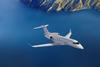
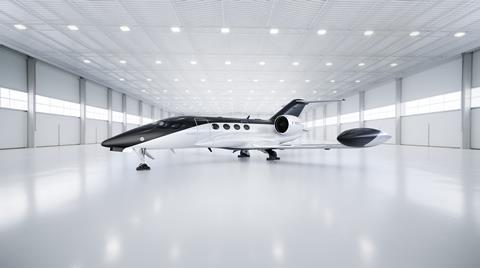
Beyond hopes to freeze the design of the BYA-1 – an 800nm (1,480km)-range jet – around 2027, with service entry to follow in the early 2030s.
In October, it announced that the aircraft’s planned 1.2MW gaseous-hydrogen-based power-generation system had reached technology readiness level 6.