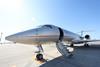








Bombardier intends to hand over “around a double-digit number” of military-role business jets before year-end as part of a fourth-quarter delivery push.
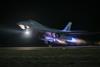
Chief executive Eric Martel says although the Canadian airframer’s defence division has only shipped four modified business aircraft across the first nine-months of the year, including the ninth Global 6000-derived E-11A to the US Air Force, the delivery pace will ramp up in the final quarter.
“In the fourth quarter you have to think of around a double-digit number,” he told analysts as he presented the company’s nine-month results on 6 November.
On top of the E-11A, Bombardier supplies airframes for several surveillance platforms, including Saab’s GlobalEye and the Sierra Nevada-developed HADES jets for the US Army.

Bart Demosky, Bombardier’s chief financial officer, says there will be “a significant number of defence aircraft, particularly Global 6500s, in the quarter”.
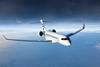
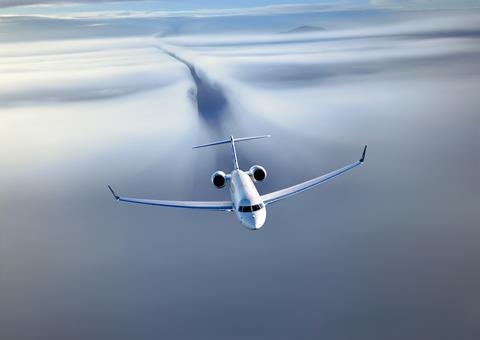
In addition, it will ship a “very large number” of Global 7500s to its traditional business jet customers during the final three months of 2025, plus the first Global 8000, which received Transport Canada certification on 5 November.
In all, the fourth quarter will account for around 40% of Bombardier’s total deliveries for the year, says Demosky. To the end of September, it had shipped 93 aircraft – 46 medium jets and 47 large – against guidance of in excess of 150 for the full year.
As demand remains strong, Bombardier will begin evaluating whether it can increase production rates for certain programmes in the period “beyond 2026”.
“We are in a great place with our backlog, but having too much backlog can also become a problem because now we are selling airplanes in 28, 29, if not more, so we have to reassess that,” says Martel.
However, Bombardier will remain “extremely disciplined” and will not raise output “if we don’t think the supply chain will follow us”.
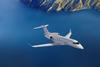
Martel declines to say which programme it is looking at, although recent speculation has focussed on the super-midsize Challenger 3500.
He also cautions that any rate rise may not come until “further than 2027”, noting it is a “long process, especially with the state of the supply chain”.
In the meantime, Bombardier has seen a significant improvement in supplier performance: “Overall shortages have gone down to a manageable level,” Martel says.
“We are now at the point where, for the first time in probably four years, we are back to what we would characterise as a normal number of late parts,” adds Demosky.
Although engines remain a pinch point, even here Bombardier is seeing progress, having received all the powerplants required for its fourth-quarter deliveries.
“We have two programmes that are in… catch-up right now [and] one remains fragile.”
Challenger 3500s are powered by Honeywell HTF7350s, Global 5500 and 6500 large-cabin jets by Rolls-Royce Pearl 15s, and Global 7500 and 8000 ultra-long-range aircraft by GE Aerospace Passport 20s.
Since reinventing itself as a pure-play business jet manufacturer following the sale of its aerostructures business and regional aircraft operations, including divesting the then-CSeries to Airbus, Bombardier has significantly improved its balance sheet and reduced its debt pile.
This, says Martel, positions the company to consider targeted acquisitions that will support the growth of its defence and services units.
In the latter case, revenue has risen from around $1 billion in 2020 to $2.4 billion in 2024. “It has more than doubled and we are not done,” he adds.
Total revenue for the nine-month period stood at $5.8 billion, up slightly on $5.5 billion in the same period of 2024. EBIT was $609 million against $536 million a year earlier.