
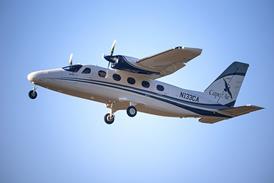
















Bristow Group is celebrating hitting 100 flights with the Beta Technologies Alia CX300 all-electric aircraft, as the operator enters the home straight on a test programme that wraps up in early 2026.
Delivered to the US firm’s Norwegian subsidiary in early August, the CX300 (N214BT) hit treble figures on 17 December, says Bristow.
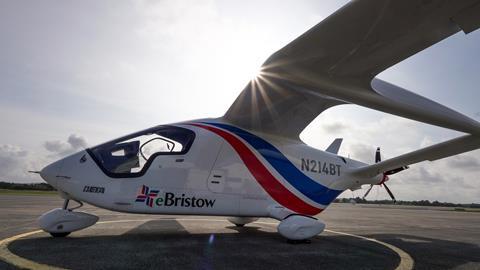
Flight-tracking data shows the aircraft performed three sorties that day: Stavanger to Bergen, Bergen to Stord, and Stord to Stavanger, during which single- and dual-pilot operations in instrument flight rules (IFR) conditions were evaluated.
For Bristow, though, hitting a century of flights came very much according to schedule, says Dave Stepanek, chief transformation officer. “Everything has been running to plan, frankly,” he tells FlightGlobal.
Bristow has split its evaluation of the pre-production asset into three phases across a six-month programme.
An initial step saw local flights around Stavanger with two pilots on board, before graduating on 4 September to sorties in visual flight rules conditions taking simulated cargo between Bristow’s bases in Stavanger and Bergen. Phase three saw IFR operations added to the mix.
“Fundamentally we have achieved what we set out to do,” says Stepanek. “We’re just going to do more IFR flights, really pressing hard on what the [energy] reserves look like and how we can do it.”
Bristow’s pilots are full of praise for how the CX300 performs, he adds: “We basically had to wipe the smiles off their faces. It’s a high-performance aircraft and it handles very, very well.
“There are minor tweaks that have to happen of course, but that’s what we are working with.”
Stepanek too has been at the controls, describing it as “one of the pinnacles of my career,” adding: “That motor behind you, the calmness of the aircraft and the ease of flying it – it was just amazing.”
As part of its test programme, Bristow also conducted a 100h inspection on the aircraft and replaced one of the five battery packs to better understand the process and any potential weak points such as fasteners.
Wear and tear has mostly been seen on the tyres and brakes – a factor of the CX300 taking off and landing at the same maximum weight.
Minor radio interference caused by the electric motor was also noted, Stepanek says, an issue resolved by moving the antennae and improving the shielding on the motor. Approval from three safety review boards – Bristow’s, Beta’s and the Norwegian civil aviation regulator’s – were required to return the CX300 to service, he adds.
“It’s really great lessons learned to have to go through that process,” says Stepanek, noting that the potential for electromagnetic interference on the vertical take-off and landing variant will be greater due to the number and size of the electric motors.
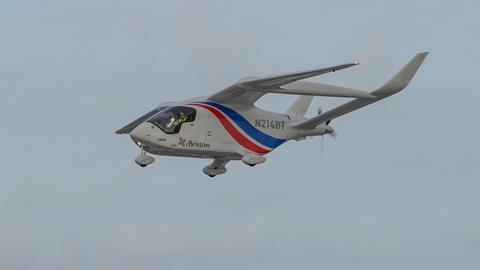
But besides these “teething issues” there have been no problems with the aircraft. “It starts every morning, and we are flying in weather, in pure IMC conditions.”
Bristow has also tested the CX300’s charging capabilities, using both the fast-charging system installed at Stavanger airport to take the batteries to 80% full and Beta’s charge cube to top them up overnight.
Charging to 80% takes, on average, around 30min, he says.
With the test programme in Norway due to wrap up by the end of January, Bristow is considering its next steps, says Stepanek.
“We are working with the Beta team to keep the aircraft in Europe and the United Kingdom area,” he says, outlining the possibility of performing over-water flights out to the Scottish Islands, for example.
The Norwegian tests have been carried out in close co-operation with the civil aviation regulator and airport operator Avinor as part of a state-sponsored advanced air mobility test environment.
Stepanek says Bristow has submitted a second proposal to the Norwegian regulator and transport ministry to carry out another round of testing using Electra’s hybrid-electric short take-off and landing aircraft.
If Bristow is successful with the application, flights are likely to begin in late 2026 or early the following year.
Bristow is a customer for both the CX300 and Electra aircraft, seeing them offering potential for onshore cargo logistics services supporting offshore oil and gas customers, before eventually adding passenger transport services to the offering.
Although Bristow’s overall experience with the CX300 has extremely positive, perhaps not everyone is entirely pleased. Stepanek recalls a conversation with a senior maintenance technician assigned to the project: “He told me: ‘Dave, I’m basically a window washer – I’ve been cleaning the windows and charging the aircraft and, every once in a while, changing a tyre’.”