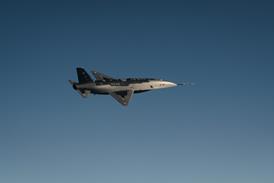











A lack of suitable European-built small turbofan engines for ‘loyal wingman’ applications that are also free of export restrictions has pushed the EU to consider funding the development of a new powerplant.
In its latest call for proposals, released on 17 December, the European Defence Fund (EDF) says it is allocating €20 million ($23 million) to “investigate the possibility to further develop a new turbofan engine” for loyal wingman and unmanned combat air vehicle (UCAV) applications.

This would be sized in the 5,620-7,870lb (25-35kN)-thrust range as research has shown this will “meet all necessary performance requirements for thrust and electric power”, it says.
“There are no suitable European and International Traffic in Arms Regulations (ITAR)-free engine available for loyal wingman applications,” it notes.
As loyal wingman platforms are seen as attritable rather than expendable assets, “the engine needs to be sufficiently reliable and cost-effective compared to the number of units produced”.
The engine needs to deliver the outlined thrust, without an afterburner, “over the entire of majority of the flight envelope” and should be capable of supporting a platform that can fly at Mach 0.95 “over a major part of the flight envelope”.
It must also occupy the same space or less than a current baseline alternative, while fuel consumption and thrust-to-weight ratio must improve.
An automated restart capability “over the main part of the flight envelope, at least during critical phases such as landing, take-off and flying below 5,000ft” should be incorporated, and it should also “support reduced detectability and increased survivability” through very low infrared and noise signatures.
Additionally, the powerplant must be able to run on a range of fuels – Jet A-1, sustainable aviation fuels, plus Mogas and Avgas – and production costs are to be minimised through “low-cost manufacturing” techniques.
While the EDF document is tilted towards the development of a new engine, it also calls for studies to analyse other engines already on the market, assessing whether there are “any potential synergies or opportunities” to use these existing products “to meet the loyal wingman needs”.
Elsewhere in the €1 billion 2026 work programme, the EDF also outlines €20 million in funding for research into new automated and automatic air-to-air refuelling technologies, including advanced sensors, image processing and flight-control algorithms.
“Although automatic air-to-air refuelling reduces the workload and improves safety for tanker and receiver crews, autonomous air-to-air refuelling is expected to be crucial for the aerial refuelling of future manned and unmanned aircraft,” it notes.
A further €24 million will be allocated to the development of next-generation self-protection systems and €25 million will go towards “smart technologies” for the avionics systems of future manned and unmanned fighters.
The EDF is also investigating the potential for a new light-attack turboprop, putting €15 million towards that effort.