









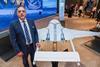

Cranfield Aerospace Solutions (CAeS) has unveiled a new hydrogen fuel cell-powered blended-wing-body uncrewed air vehicle (UAV) in a move that marks a significant shift for the UK company’s strategy.
Boasting a 5.5m (18ft) wingspan, the ST-5 Stingray is designed for surveillance, cargo, or search and rescue missions.

Launched in June 2025, first flight of the ST-5 is scheduled around the turn of the year and additional demonstrators are then scheduled to follow, says CAeS.
The first aircraft is already structurally complete and installation is under way of the off-the-shelf propulsion system and CAeS-developed control system.
“With an ambitious schedule of just seven months, I am incredibly proud of the team here and all they have achieved to date,” says CAeS chief executive Hanif Nabi.
Designed around a twin-boom configuration, the Stingray features an air-cooled fuel cell system generating 8kW of power to drive a pair of electric motors in a pusher layout. A small battery pack is also included to deal with peak power demands.
Although designed around a fuel cell powertrain, the Stingray can also be configured to use a kerosene combustion engine or battery-hybrid propulsion system.
The ST-5 is the first of a planned four-model family of UAVs, running all the way to the 2,000kg (4,410lb)-payload, 18m-wingspan ST-18.
CAeS says it has already signed a memorandum of understanding for the ST-5 with the UK’s National Oceanography Centre for maritime mapping. If converted to a firm order, first delivery could take place in 2027.
However, the switch to a new UAV is a significant change in strategy for CAeS, in which the UAE government’s Strategic Development Fund (SDF) is a significant investor.
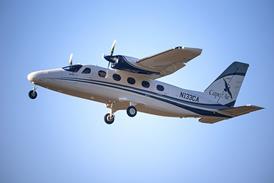
It had previously focused on the development of a 250kW hydrogen powertrain for retrofit and new-build applications – including for the Britten-Norman BN-2 Islander – an effort that is now on hold.
Nabi says the currently challenging investment market and “the amount of money it would take” to bring that powertrain into service meant the “commercial case would not stack up”.
Instead of seeking additional funding to advance the powertrain – developed under a UK Aerospace Technology Institute-backed project – CAeS decided to pivot to the Stingray drone family.
This draws on design experience accumulated during its involvement in the Boeing X-48 programme and the more recent acquisition of control-system design capabilities.
“We had a number of people who were in the right place at the right time,” he says.
All three of CAeS’s major shareholders backed the new direction, says Nabi, with SDF also investing additional funds.
Although the ST-5 uses commercially available fuel cells and electric motors, Nabi sees the UAV as a “stepping stone” to a larger aircraft “that uses the liquid-cooled powertrain that we have already developed but not yet tested”. CAeS’s specification sheet shows the ST-18 would require around 800kW of total power.
However, the pause to the 250kW powertrain also means a memorandum of understanding with Dronamics is also frozen.
In 2022, CAeS and Dronamics – another company in which SDF has invested – agreed to jointly study the integration of the fuel cell propulsion system into the latter’s Black Swan cargo drone.
A follow-up pact a year later committed to the installation, with deliveries supposed to start in 2026. That agreement is “still extant”, says Nabi, “but we are busy doing our own thing”.
He is hopeful the switch to drone development will allow CAeS to become ”self-sustaining”, lessening the reliance on its shareholders for continual cash injections and also paying for future development work. For that reason, the business is also “regrowing” its engineering consultancy operation as it seeks additional revenue streams.