












As the Pentagon rushes to prepare for a potential conflict with China in the Western Pacific, the US Air Force (USAF) is set to receive a new top officer with deep experience in the region.
General Kenneth Wilsbach has been nominated by the White House to be the next air force chief of staff, replacing the current officeholder General David Allvin, who in August unexpectedly announced his retirement halfway through a four-year term.
Such appointments must be confirmed by the US Senate, although an officer with Wilsbach’s resume is unlikely to face any opposition.
Wilsbach most recently oversaw Air Combat Command (ACC), which includes responsibility for the USAF’s more than 1,700-strong force of tactical fighters.
Before taking the helm at ACC, Wilsbach spent four years as the commander of Pacific Air Forces – the top USAF officer in the strategic Indo-Pacific region.
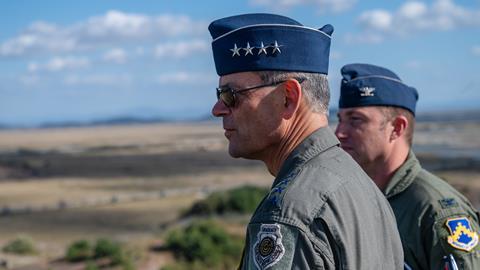
Interestingly, Wilsbach had been set to retire from active military service and was already on leave after relinquishing command of ACC in August.
Four-star officers at such senior ranks have relatively few billets available to them and are typically forced into retirement if not selected for an open position.
President Donald Trump has a history of intervening to find work for his preferred generals and admirals who have failed to ascend to the rarefied chief of staff level.
During his first term, Trump tapped US Navy Admiral and Indo-Pacific Command chief Harry Harris to be his ambassador to South Korea after Harris was passed over to be the chief of naval operations.
More recently, Trump called then-retired Lieutenant General Dan Caine back to active service earlier this year, nominating him to be chairman of the joint chiefs of staff, with promotion to four-star general.
While the details of what transpired around the Allvin retirement and Wilsbach nomination are not publicly known, the combat pilot is the type of fighting leader for whom Trump has often demonstrated an affinity.
Wilsbach is rated on the Boeing F-15A/B/C/D, Lockheed Martin F-16C and Lockheed F-22, with more than 6,000 flight hours. He has logged 71 combat missions, according to the air force.
Notably, his wife Cynthia Wilsbach has served as a White House aide during both the first and second Trump administrations. White House budget documents from July list her as an active employee responsible for writing presidential correspondence.
Secretary of the air force Troy Meink on 30 September said he supports the choice of Wilsbach to be chief of staff, calling him a “combat tested aviator” with experience leading combat forces around the world.
“I also believe he will be a great partner to help continue advocating for the capabilities the air force needs not just for today, but also in the future to make sure we remain the most lethal air force in the world,” Meink says.
In previous roles, Wilsbach has been at the centre of some of the most pressing issues facing the USAF, including calling for further investment in air superiority technologies after the sighting of next-generation combat jets over China throughout the past year.
As ACC commander, Wilsbach oversaw efforts to integrate autonomous combat platforms with existing fighter jets, including flight tests involving the F-15E and F-16C working with the Kratos XQ-58A uncrewed aircraft.
He also oversaw the fielding of the first L3Harris/Bombardier EA-37B electronic attack jet last year.
In the Pacific, Wilsbach called out challenges with the ageing Boeing E-3 Sentry airborne warning and control platform, highlighting the Cold War aircraft’s persistent maintenance issues and problems with sensor obsolescence when facing off against China’s low-observable Chengdu J-20 fighter.
“When it gets airborne, those sensors that we rely on with the E-3 aren’t really capable in the 21st Century fight, especially against a platform like the J-20 or something similar to that,” Wilsbach said in 2022. “It just can’t see those platforms far enough out to be able to provide an advantage to the shooters.”
As the Pacific Air Forces commander, Wilsbach supported the idea of the USAF fielding the Boeing E-7A Wedgetail as a successor the E-3.
While that service moved to do so under the administration of President Joe Biden, the Trump Administration officials at the Pentagon are now seeking to cancel the costly procurement effort, which they view as already obsolete and overly vulnerable on the battlefield.
Should he be confirmed, the E-7A issue is likely to be an early test of Wilsbach’s standing within the administration as a military expert.