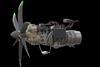













Pratt & Whitney (P&W) and Boeing are asking the Federal Aviation Administration for more time and for regulatory exemptions as part of design changes they are making to PW4000-112 turbofans and the 777s they power.
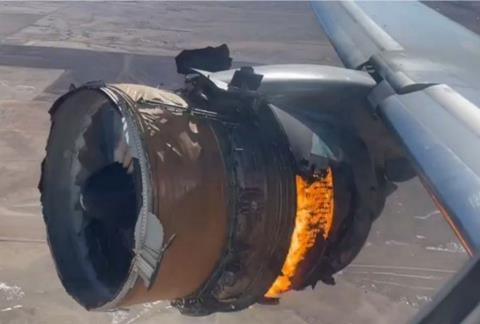
The companies are developing the changes in response to several in-flight fan-blade failures affecting PW4000-112s – the variant that powers 777s. The incidents significantly damaged the engines and surrounding structures. At least one event ignited an engine fire.
As part of its redesign work, P&W on 25 August asked the FAA for a regulatory exemption to a specific blade-out testing rule.
It said an approval “would enable introduction of PW4000-112 design improvements as well as continued operation of the Boeing 777 for a major domestic air carrier”.
Boeing, P&W and airlines are up against an FAA-set 4 March 2028 deadline by which 777s with PW4000s must have design changes. No such requirements apply to 777s powered by GE Aerospace GE90 or Rolls-Royce Trent turbofans.
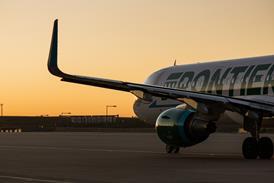
P&W does not name the “major” airline cited in its regulatory filing. But United Airlines is only US carrier operating PW4000 powered 777s, with 52 of the type, according to fleet data provider Cirium.
United declines to comment.
“Adverse integrated engine/airframe field event outcomes following fan-blade fractures in the airfoil portion are driving type design changes to the PW4000-112,” P&W’s filing says.
“The proposed exemption would enable improvements to the engine, while providing an equivalent level of safety,” the engine maker, an RTX subsidiary, tells FlightGlobal.
JOINT P&W-BOEING PROJECT
P&W is working alongside Boeing, which is addressing the problem with its own changes.
Boeing tells FlightGlobal it and P&W are finalising “complex hardware updates that will further improve the engine design to mitigate the impact of a fan-blade failure”.
“We continue working closely with our customers and Pratt & Whitney, under the oversight of the FAA, to ensure the ongoing safe operation of 777-200s and 777-300s” powered by PW4000s, Boeing adds.
Three notable fan-blade failures have afflicted 777s with PW4000s, the most recent involving a United 777-200 in February 2021. One of that jet’s engines lost a blade shortly after take-off from Denver, damaging the engine and surrounding structures, sending debris falling and igniting an engine fire.
The National Transportation Safety Board said the blade failed due to metal fatigue and that the fire started after hot gas was released due to a flange failure.
A United 777-200 suffered a similar PW4000 failure in February 2018, as did a Japan Airlines 777-200 in December 2020.
The most-recent incident prompted Japan, the UK and the USA to ground PW4000-powered 777s. The FAA also issued airworthiness directives requiring repetitive inspections, tests, inlet modifications and installation of debris shields.
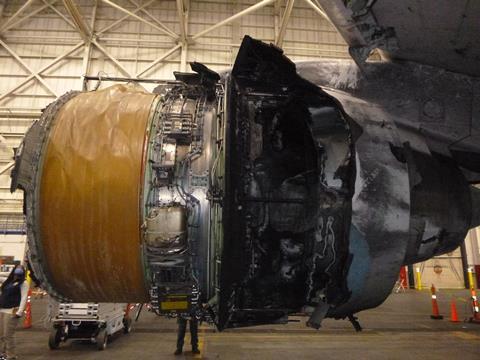
In 2021, Boeing said it was addressing the risk by making inlet and cowl modifications to help engine structures withstand “large-span [fan-blade-out] events that led to unexpected departure of nacelle structure”.
Boeing revealed the changes in an October 2021 regulatory filing in which it asked the FAA for temporary exemptions from airworthiness rules. It said the exemptions would allow airlines to return 777s to service while Boeing completed the tweaks.
The FAA approved the request in March 2022, and airlines soon returned 777s to duty. The approval gives Boeing until 4 March 2027 to submit design changes to the FAA and requires airlines implement the changes by 4 March 2028.
The redesign is taking longer than envisioned. In May, Boeing asked the FAA for another 5 years, meaning airlines would have until 4 March 2033 to incorporate the changes.
“Boeing and Pratt & Whitney have not yet identified integrated design modification concepts that could be shown to be fully compliant,” Boeing’s request said.
Boeing and P&W “identified additional incremental design improvements concepts” that are “predominately Pratt & Whitney engine hardware changes”, Boeing added.
Those include “changes to the engine core case fastening hardware system” intended to mitigate flange separation, and “engine external hardware” changes to “reduce the severity” of engine fires.
Boeing also argued for more time on grounds that modifications to in-service jets should be completed in engine shops, and shop space is limited.
“If approved, this extension would provide operators more time to incorporate the updates into their fleet. In the interim, the fleet remains subject to a rigorous inspection programme,” Boeing says.
The FAA typically responds to exemption requests within 120 days but told Boeing it will likely need more time, citing “complexity”.

In a June letter to the FAA, the Air Line Pilots Association, International expressed “concerns” about pushing the requirement out another five years, which would push the deadline to 12 years after the 2021 incident.
“ALPA would encourage Boeing and Pratt & Whitney to work to expedite the timeline to develop a permanent fix that would not require an additional five years for design approval,” the union said.
United is behind Boeing. In July, the airline asked the FAA to grant another five-year extension, calling the current timeline “not feasible”.
The regulatory exemption now sought by P&W would free the company, as part of its redesign work, from needing to comply with an airworthiness rule related to fan-blade failure tests.
The rule in question requires manufacturers to complete tests demonstrating that turbofans can withstand damage from fan-blade failures that occur at a blade’s “outermost retention groove”.
P&W notes it already completed that test during the PW4000-112’s certification campaign.
Instead of that test, P&W proposes that it be allowed to test the engine’s resilience to a blade that fails at a location similar to the “actual field failures”.
The FAA also told P&W it will likely need more than 120 days to reach a decision.