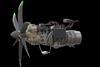


















RTX in recent years filed patent applications for technologies related to open-rotor engines, though the company insists it remains committed to developing an updated geared turbofan (GTF) for powering future narrowbody jets.
The United States Patent and Trademark Office published the patent documents between June and July.
RTX subsidiary Pratt & Whitney (P&W) and competitor CFM International have publicly committed to pursuing wholly divergent engine-development tracks. Much is at stake, as the companies intend to offer products for the next-generation single aisle jets Airbus and Boeing are expected to introduce in the 2030s.
CFM, jointly owned by GE Aerospace and Safran Aircraft Engines, has thrown itself into developing an open-rotor engine under its Revolutionary Innovation for Sustainable Engines programme. Also called unducted fans, open rotors lack surrounding structures and allow for wider fans. CFM is shooting for 20% fuel-efficiency gains.
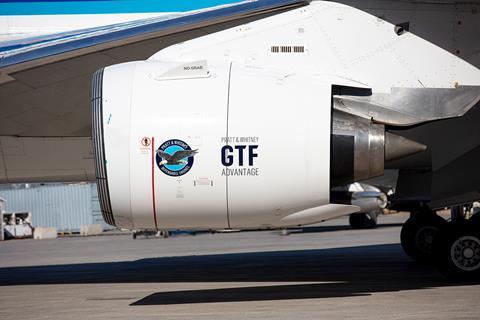
But RTX subsidiary P&W has insisted an open fan is not the best solution. It has taken a different approach it calls less risky: developing an updated, more-efficient version of its GTF. Current variants of that engine now power Airbus A220s, A320neo-family jets and Embraer E-Jet E2s.
P&W insists it remains committed to that path.
But in the last two years, RTX sought several patents covering features specific to open-fan engines. It describes the applications as part of a long-running effort to develop advanced engine technologies.
On 8 July, the US Patent office issued RTX a patent covering an “open-rotor variable-pitch blade with [a] retracting inboard trailing edge”. The patent says variable-pitch blades, when pivoted, can leave “significant gaps” between the blades and endwalls, reducing efficiency.
RTX’s solution is blades with adjustable edges and an actuating device that extends the edges to close the gaps, the patent says.
“Open-rotor or unducted fans have been considered as alternatives to ducted fans to provide for higher bypass ratios and better specific fuel consumption,” RTX’s patent says. “Open-rotor architectures typically incorporate variable-pitch blades… to allow for a range of thrust levels (including reverse thrusts) over a relatively small rotational speed range.”
The Patent office on 19 June published an RTX patent application covering an open-rotor engine anti-icing system. The design involves bleeding and directing “heated gas to the guide-vane structure to reduce or prevent ice accumulation on the guide vanes”.
In May, the agency published two RTX patent applications covering an open-rotor engine cooling system. It involves a heat exchanger and air inlet within a rotor’s nose cone.
Those applications say bypass air moving through ducted turbofans is pressurised owing to the surrounding housing, making the air suitable for cooling heat exchangers. But air moving through open-rotor engines has ambient pressure owing to the lack of a housing, meaning “obtaining cooling air can be a challenge”.
P&W tells FlightGlobal the documents reflect no shift in strategy and that it remains committed to developing a conventional, ducted GTF update for the next iteration of narrowbody jets.
“As part of our ongoing efforts to explore new propulsion concepts, Pratt & Whitney has studied and filed patents for open-rotor technologies going back several decades, including as recently as last year,” the company says. “Based on our research, we concluded that the installation and integration challenges associated with an open-rotor architecture would reduce the potential fuel burn benefit, thus reinforcing our conviction that the second-generation ducted GTF engine architecture remains the right path forward for [next-generation single-aisle jets].”
In May, P&W said its second-generation GTF will have composite fan blades, materials made from ceramic-matrix composites (CMC), and possibly hybrid-electric capabilities.

Open-rotor engines do pose engineering challenges. They have historically been louder than turbofans and they lack containment rings – structures on ducted turbofans intended to keep failed engine components from striking aircraft structures and systems. One solution to that challenge can be reinforcing an aircraft’s fuselage, but doing so can add weight, reducing efficiency benefits.
Open fans derive improved efficiency because ditching nacelles and other surrounding structures eliminates drag and allows them to have wider fans. Being novel designs, open fans could leave some customers wary considering the durability shortcomings affecting today’s turbofans.
CFM insists its RISE open fan will be a winner. It has said that, thanks to advanced computing, it can design an open fan that is quieter than today’s turbofans. CFM also says it has a solution to the containment challenge.
The RISE demonstrator will have a single fan with variable-pitch composite blades forward of static vanes, and a “compact” core containing CMC materials that will burn hotter and at higher pressures than traditional turbofan cores. A hybrid-electric system is also being developed, CFM has said.
“As part of the CFM RISE demonstration programme, we’re advancing innovative new technologies to meet our customers’ needs and believe Open Fan is the most-promising path to achieve a step change in efficiency and durability,” CFM tells FlightGlobal.
The company declines to say if it is also pursuing development of a future conventional ducted turbofan in case RISE trips up. However, GE executives have said technologies being developed through RISE can apply to other powerplant designs.