










Elected lawmakers in Washington, DC are taking action to protect the US Air Force’s acquisition programme for the Boeing E-7A Wedgetail, which the White House is seeking to cancel.

What has been described as the final draft of the annual defence policy bill known as the National Defense Authorization Act (NDAA) includes multiple provisions intended to prevent the Pentagon from winding down the USAF E-7A effort, which is currently in the prototyping phase.

Under the Biden Administration, the air force contracted with Boeing to develop the E-7A as a modernised airborne early warning and control (AEW&C) platform to replace the service’s ageing fleet of Boeing E-3 Sentries.

The air force currently has two prototype E-7A examples under contract with Boeing, with those aircraft to be used as test articles for refining final requirements for an eventual fleet of 26 operational jets.

However, the Trump Administration has publicly opposed that plan, with senior officials including Pentagon chief Pete Hegseth describing the E-7A as unsuited to modern air threat environment.

“If we have systems and platforms that are not survivable in the modern battlefield, or they don’t give us an advantage in a future fight, we have to make the tough decisions right now,” Hegseth said during congressional hearings in June.

“The E-7 is an example of that,” he added

Instead, the Trump Administration is pushing for an as-of-yet unproven space-based solution to airborne threat tracking, with an additional purchase of new-build Northrop Grumman E-2D Advanced Hawkeyes as an interim solution for phasing out the E-3 fleet.

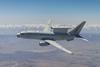
E-7 in flight

Source: US Air Force

Australia has operationally deployed its E-7As to the both the Middle East and Europe, and is now pioneering techniques for teaming the airborne early warning and control jets with the country’s MQ-28 Ghost Bat autonomous combat aircraft

Lawmakers in Congress have opposed that plan for months and are now moving to fend off any efforts to kill the E-7A – at least for now.

The 2026 NDAA legislation takes a carrot-and-stick approach that both incentivises the Pentagon to move forward with an operational Wedgetail fielding and prevents spending any congressionally allocated funds on shuttering the programme.

“None of the funds authorised to be appropriated by act or otherwise made available for fiscal year 2026 for the Department of Defense may be obligated or expended to terminate the mid-tier acquisition rapid prototype contract for the E–7A aircraft [or] to terminate the operations of… a production line for the E–7A aircraft,” the bill states.

Boeing is scheduled to deliver the two prototype Wedgetails in 2028, with a production decision on the full fleet to follow thereafter.

The 2026 NDAA also includes an incentive for the Pentagon to move forward with that fielding.

If the bill becomes law, it would require the USAF to maintain an E-3 fleet of at least 16 aircraft – a slight reduction from the current inventory of 17 examples.

However, that restriction can be waived if air force “procures enough E–7 Wedgetail aircraft to accomplish the required mission load”.

That exemption notably would not take effect until after the requisite E-7A capacity has been delivered to the USAF.

Congressional lawmakers are proposing to add significantly more fiscal support to the E-7 prototyping effort in FY2026, with the draft NDAA including $846 million versus the $199 million requested by the Trump Administration.

Those funds are earmarked for “continued development and procurement”.

The US Senate has already passed its version of the NDAA, while leaders of the Armed Services Committee in the House of Representatives are preparing to table the bill for a vote in the lower chamber.

The committee’s Republican chairman Mike Rogers and Democratic ranking member Adam Smith both say the revisions made by lawmakers in the House have been approved by their colleagues on the Senate Armed Services Committee – paving the way for passage of the NDAA in both chambers.

If the bill is approved by the House and Senate, it will still require the signature of President Donald Trump to become law.

The US decision on E-7A procurement could have significant consequences overseas.

In November, a coalition of seven European NATO countries said they would drop plans to purchase six Wedgetails as a replacement for the ageing fleet of E-3s owned by NATO headquarters.

The group cited Washington’s apparent decision to abandon its own E-7A programme as justification.

“The members are now exploring alternatives for replacing the fleet and are looking for new partners,” the Dutch defence ministry.

Alongside the Netherlands, Belgium, Denmark, Germany, Luxembourg, Norway and Romania were signed onto the plan, which included financial backing from the USA.

The group is expected to re-examine Saab’s Bombardier Global 6500-based GlobalEye AEW&C platform, which the Swedish manufacturer had previously put forward for the tender.

A US reversal on the E-7A could revive prospects for a Boeing sale to Europe.

However, Europan leaders have become increasingly vocal about their desire to reduce reliance on the USA for defence purchases and instead procure equipment from manufacturers in the UK or European Union.

The US vacillations on the E-7A may ultimately provide a convenient excuse for a shift toward a European provider to fill the AEW&C requirement.