














South Korea has kicked off development of its new electronic warfare (EW) aircraft during a meeting with defence contractor LIG Nex1.
The meeting about the planned Block I capability involved a range of government agencies involved in the effort to develop an EW aircraft, according to South Korea’s Defense Acquisition Program Administration (DAPA).
According to the DAPA, the overall investment into the capability will be W1.9 trillion ($1.3 billion). The system will be deployed in 2034 after testing and evaluation.
In addition to the DAPA, meeting participants included LIG Nex1 (which will lead research and development), military leaders, the Agency for Defense Development, and the Defense Agency for Technology and Quality.
“The electronic warfare system developed through this project will go beyond the limited protection provided by existing electronic warfare equipment for individual weapon systems,” says the DAPA.
“It will be a game-changer in future battlefields, capable of jamming wide areas from a distance, blinding the enemy and securing control of the battlefield. This is expected to dramatically improve the survivability and joint operation capabilities of our air forces.”
In December 2025, a LIG Nex1 stock exchange disclosure said that the company had won a W1.6 trillion ($1.1 billion) EW contract from the DAPA, covering research and development as well as systems integration for the new aircraft.
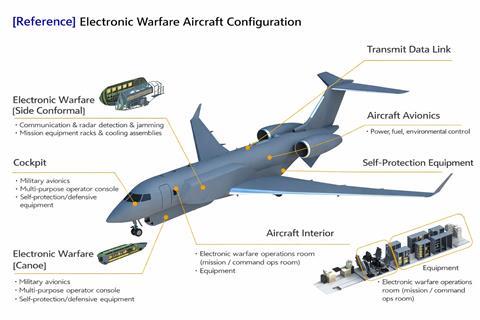
Three months earlier, in September 2025, Korean Air confirmed that its joint bid with LIG Nex1 to develop an EW aircraft based on the Bombardier Global 6500 business jet had moved ahead of a rival bid from Korea Aerospace Industries and Hanwha Systems.
“Electronic warfare is a new concept weapon system that will be a game-changer on the future battlefield, and the start of this development will be a crucial milestone that will shift the paradigm of future warfare,” says Jeong Gyu-heon, head of the Future Power Business Division at the DAPA.
“We will work closely with relevant organisations and do our utmost to ensure the success of this development and manage the project thoroughly.”