

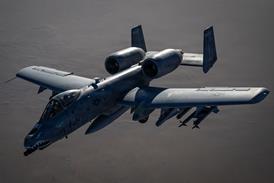
















The US Navy (USN) is funding research into a new science project that at first glance sounds almost alchemical: turning seawater into jet fuel.
That may seem like science fiction, but the Pentagon’s naval research lab thinks shipboard fuel synthesis could be possible and is providing research and development funds to explore operationalising the technology.
If proven effective, the seawater-to-fuel conversion process could streamline naval logistics and unlock significant new tactical and strategic possibilities for Washington.
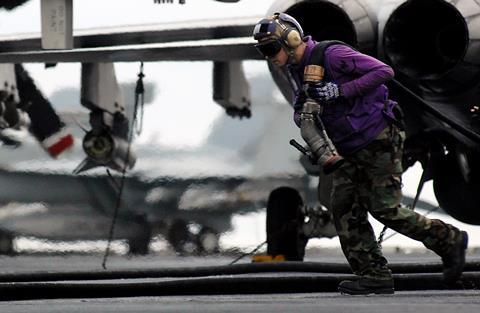
Consider a scenario in the not-so-distant future where one of the USN’s aircraft carriers is hiding deep in the vast expanse that is the western Pacific Ocean.
The flattop ship and its escorts have been forced far out to sea by the threat of long-range Chinese missiles, backed by orbital and airborne reconnaissance assets, which began hunting the carrier strike group after Beijing ordered a maritime quarantine of Taiwan.
Ships and aircraft for the People’s Liberation Army, bristling with anti-ship missiles, now ring the besieged island.
Although the US carrier is still generating sorties to probe the Chinese defences while Washington mulls a response, the strike group has been forced more than 1,000nm (1,850km) to remain safe from China’s vast arsenal of “carrier killer” weapons – including YJ-12 air-launched anti-ship missiles and shore-based anti-ship ballistic missiles, including the DF-21D and DF-26.
That latter category carries a range beyond 2,000nm.
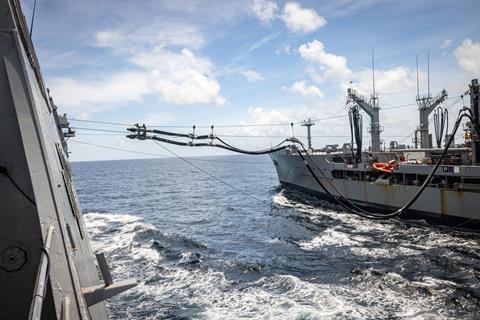
As a result of the stand-off, the carrier’s embarked air wing is forced to fly long-range sorties, with each aircraft refuelling multiple times per flight. Onboard stores of JP-5 jet fuel are being depleted, but the one-star admiral in command of the strike group is reluctant to rendezvous with one of the navy replenishment ships steaming across the Pacific – presumably under watch from Chinese reconnaissance satellites.
Instead, the strike group commander orders the captain of the carrier to fire up an experimental onboard generator, one that can produce fuel from the surrounding ocean water.
The navy thinks the concept holds enough promise that it is funding development of a maritime fuel production system that could be deployed aboard combat ships.
In August, the service issued a $9.4 million contract to a Texas-based company experimenting with a process that pulls carbon dioxide and hydrogen from seawater to synthesise jet fuel.
That firm, called Sea Dragon Energy, says that ocean water contains carbon dioxide in concentrations roughly 140 times that of air. Water is comprised of two parts hydrogen and one part oxygen.
Under an initiative called Project Genesis, Sea Dragon is developing a system that could pull those raw material from seawater and convert them into a fuel equivalent to JP-5 – a process roughly analogous to the refining of sustainable aviation fuel (SAF) from agricultural products.
“The ability to do this in an efficient manner is precisely what Project Genesis is aiming to do,” Sea Dragon says.
The company notes that the US Naval Research Laboratory has already patented technology that allows extraction of carbon dioxide from seawater and simultaneously produce hydrogen.
The goal now is to integrate that extraction process with a SAF production plant that is appropriately sized and efficient enough for shipboard operation.
“Preliminary studies of naval operational scenarios and naval architectural design suggest that a seaborne version of the process could sustain a carrier strike group’s operations indefinitely,” Sea Dragon says.
“This ability is a huge advantage for the navy in a potential conflict situation,” the company adds.
Efficiency will be key to making the process viable in any real-world context. A 2014 report in Smithsonian Magazine noted the technology available at the time would require nearly 9 million cb m (318 million cb ft) of water to make 378,541 litres (100,000 USgal) of fuel – assuming 100% efficiency in the extraction and refining process.
Even outside an active conflict, Sea Dragon says the technology could reduce fuel and operating costs for the navy, while providing the service more flexibility and a reliable fuel supply.
The Pentagon famously converted its aircraft carrier fleet to nuclear propulsion when it commissioned the USS Enterprise – the world’s first nuclear-powered carrier – in 1965.
Nuclear reactors are standard on all of the currently-serving Nimitz-class carriers, which entered service in the 1970s, and the new Ford-class flattops – the first of which is now actiely generating sorties on the global frontlines.
While those floating airfields must still take on consumables, each carrier effectively has unlimited range and ample onboard power generation for functions like generation of fresh water via desalination.
An onboard jet fuel production capability could unlock a similar future for air wing operations, bound only by availability of spare parts and physical requirements of human crews.
Sea Dragon’s latest contract follows an even larger $19 million award from the navy in 2024 to design and build a seawater-to-jet fuel demonstrator unit.
Work on phase two of the project, which is funded by the August contract, will take place in San Diego over a two-year period, concluding in 2027.
That date notably coincides with the window after which senior US military and intelligence officials say Chinese premier Xi Jinping has ordered the PLA to be ready to seize Taiwan, should he give the go-ahead.
Washington’s top officer in the Indo-Pacific says China is now actively rehearsing for such an operation, which could come in the form of a coercive blockade or an outright invasion.