
















Panama’s Copa Airlines may not convert options it holds for more than a dozen Boeing 737 Max 10s into orders, as chief executive Pedro Heilbron expresses satisfaction with the carrier’s current mix of Max 8s and Max 9s.
Copa holds unfilled orders for 15 737 Max 10s.
Boeing recently disclosed that the Max 10, already years behind schedule, is now targeted for US Federal Aviation Administration certification in 2026. It is the most-stretched variant in the latest-generation 737 family.
Copa committed to acquiring the Max 10s at the 2017 Paris air show, when it converted production slots it held for previously ordered Max jets.
But Heilbron recently told FlightGlobal Copa is “not sure we’re going to take it” when the Max 10 finally becomes available, adding that the carrier is “quite happy with the combination of Max 8 and Max 9”.
“It may well be that we stay with the Max 8 and Max 9 combination; that’s yet to be decided,” he says.
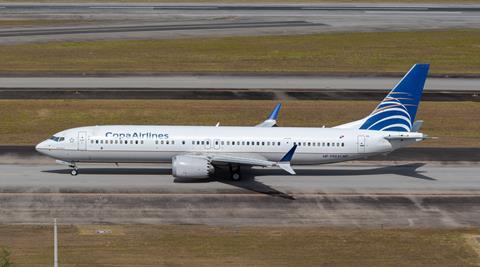
At the end of the second quarter, Copa operated 115 jets, including 67 737-800s, nine 737-700s, 32 Max 9s, six Max 8s and one 737-800 Freighter, according to securities filings. The carrier has since taken delivery of its seventh Max 8.
Copa’s Max 9s generally fly routes between 4-6h, and longer legs from Panama City to Buenos Aires, Sao Paulo, Los Angeles and San Francisco.
The airline is using its incoming Max 8s to replace 737-800s, which remain Copa’s workhorse aircraft.
“Once Boeing stopped producing the -800, the logical transition was to the Max 8; same size, same configuration,” Heilbron says.
Copa uses 737-800s and Max 8s on short- and medium-haul routes within Central America and the Caribbean.
Copa has considered ordering Max 7s, the smallest but longest-range Max variant, but has no plans yet to do so. That jet has also not yet received FAA certification, but Boeing expects to pass the milestone also in 2026.
“It’s a nice aircraft, but we try hard to limit the number of different configurations we have because it adds complexity,” Heilbron says.
Unless its fleet strategy changes, Copa’s 737-700s – which are 19-25 years old, according to aviation analytics provider Cirium – will eventually be replaced by larger Max 8s.
An order for Max 7s could happen “in the medium term” as a replacement for 737-700s, Heilbron concedes. “But right now, I don’t think we would add another configuration.”
The same applies for broadening Copa’s scope by acquiring long-haul widebody jets – doing so would add too much complexity and pose cost-management challenges.
“We focus on very disciplined execution of our business model, and we work hard not to distract ourselves with ideas which might sound great but are not necessarily our thing,” Heilbron says. “We cooperate with all the European airlines that fly to Panama, and we help them provide good service to our country.
”We also feed our network and feed them from our network, but we have no plans to bring in widebodies and fly across the Atlantic.”
Heilbron does not rule out Copa eventually breaking away from being an all-Boeing operator.
Flying only 737s “is the reality right now, but it doesn’t necessarily need to be the reality forever”, he says when asked if Airbus of Embraer jets could be on the horizon. “We like being a single-type operator.”