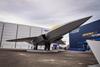







An undisclosed customer has secured reservations for three Hybrid Air Vehicles (HAV)-produced Airlander 10 aircraft for use in support of military tasks – the first examples of the type “destined for defence use”.
“The three aircraft have been reserved by an innovative defence contractor looking to deliver the unique capabilities of Airlander to its customers,” the UK company announced on 23 October. The assets will undergo “further customisation” for the future operator, it says, without providing further details.
“Whether equipped with multispectral sensor suites for ISR [intelligence, surveillance and reconnaissance] roles, using the space to transport personnel, materiel and equipment to austere environments, or to hold, release, and recover drone swarms, Airlander offers new possibilities in defence,” it claims.
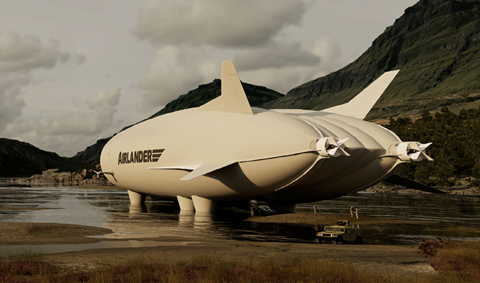
A sensor payload of up to 3,000kg (6,610lb) could be carried by the Airlander 10 in support of duties such as ISR, missile-defence, counter-drone and maritime surveillance operations, it suggests.
HAV describes the type as having a “large, rapidly reconfigurable cabin, perfectly suited to meeting the fast-paced and ever-changing needs of the military market”.
It also points to its unrefuelled flight endurance of up to five days, “robust survivability and low vulnerability”, and ability to operate “from any relatively flat surface, including water” as attributes supporting adoption by the military.
“As warfare evolves to meet current threats this capability is ever more valuable, and we have worked hard to showcase the aircraft’s capabilities,” says HAV executive director sales George Land. “We expect other military reservations to follow,” he adds.
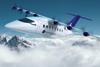
HAV claims to now have a “military pipeline” valued at $3.7 billion, along with reservations worth $2 billion for the civil sector, where its aircraft will be used to transport more than 100 passengers, or a maximum cargo load of 10t.
The developer expects its Airlander 10 to enter testing in 2027, with the product to be built at a site in Doncaster in the north of England.
HAV also believes its hybrid airship design could be scaled up to provide bigger variants, potentially offering a payload capacity of up to 200t. “The Airlander Futures Network has been established and is working with market shapers in logistics to refine the specification of these larger aircraft,” it says.