














Dassault Aviation’s pugnacious chief executive Eric Trappier has raised the temperature in his ongoing war of words with Airbus, repeatedly insisting its supposed partner was jeopardising the Future Combat Air System (FCAS) programme as it “does not want to work with us”.
Indeed, the programme to develop a manned next-generation fighter and accompanying unmanned assets for France, Germany and Spain now appears to be edging closer to collapse.
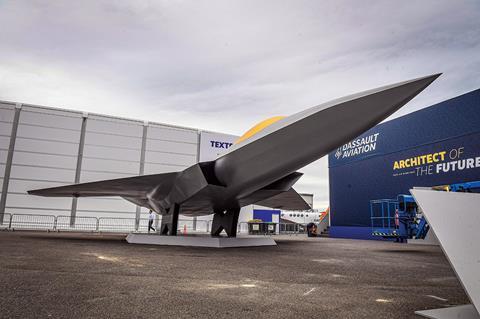
Presenting the French airframer’s 2025 results on 4 March, Trappier repeatedly said the problem lay not with Dassault but was caused by the fact that “Airbus does not want to work with us”, describing its partner as “aggressive” and “arrogant”.
“What I know is that if Airbus does not want to work with Dassault the project might not go through.”
And to illustrate the depth of the company’s doubts about FCAS, Trappier introduced the topic by displaying a slide which was blank save for a large question mark.
As evidence for his position, he referenced comments apparently made by Airbus chief executive Guillaume Faury during the group’s 19 February full-year results presentation.
But Airbus points out that Faury did not refuse to work with Dassault, merely expressed his views on the reasons for the current impasse.
“On the next generation fighter, there is a deadlock that is linked to expectations on the governance that differ between partners, on what leadership means, what co-operation means. That’s one of the reasons for the difficulties,” Faury said.
“Also, under a certain governance, on the ability to reach the objective of the programme for the different customers.”
While publicly insisting there is no rift, it is thought that Airbus is struggling to agree to Dassault’s demands.
Trappier asserts that France, and therefore Dassault as its industrial champion, was guaranteed leadership of the manned element of the programme, the New Generation Fighter (NGF), at the project’s inception in 2018.
At that point FCAS was a joint Franco-German initiative, with Dassault and Airbus the respective industrial champions. However, the inclusion of Spain in 2019 – lead by Indra but represented by Airbus on the NGF component – complicated the governance structure and workshare balance.
Trappier says Dassault accommodated the change – and a subcontractor position on other parts of the programme – on the understanding that it retained the leadership of the NGF development.
“We really need to say that from the get-go France was supposed to be the leader on this project,” he says, arguing that a structure in which there are “co-leaders” will not work.
“Not everyone is happy with the Dassault leadership but if you want to have that kind of combat aircraft for the future you need a leader. I’m not the one who decided who the leader was going to be.
“The decision makers – the states – were the ones to decide, and the idea was to make that decision on the basis of who was the ‘best athlete’.”
He also contrasts Dassault’s behaviour with that of its partner: “We have been complying with the terms of the [FCAS] contract since the very beginning; Airbus has not.”
Dassault, he says, “has adapted to the circumstances”, while Airbus has been less flexible: “I don’t think it is a good idea for them to point fingers.”
Although maintaining he does not want to disparage its partner unnecessarily, Trappier says Airbus “does not have the same skills” as Dassault to lead the development of a new fighter. “It’s been like that for years, decades even.
“I have always been respectful of Airbus – I have never said I didn’t want to work with them [but] they are being aggressive and saying they do not want to work with us.” Such statements were “arrogant”, he adds.
Germany has also recently muddied the waters, suggesting that the different operational requirements between the FCAS partner countries could require a two-aircraft solution.
Faury appeared open to that proposal and the potential inclusion of additional partners. However, he emphasised it would be down to the customers to decide.
“We believe that if there’s a way forward with two fighters, it could be an opportunity to have other partners with us. It is up to our customers to decide with whom they want to join forces though, if it were the case.”
But Trappier pushes back, saying that “France does not support this idea of having two aircraft”.
The partners are currently designing the NGF through the FCAS programme’s Phase 1B, but as yet there is no contractual agreement on how this would be turned into a flying demonstrator during Phase 2, a milestone that was meant to have been signed off last year.
Describing the process as “lagging behind”, Trappier says the nations “really need to think about what we are going to do in future for in-flight trials”.
“We still have a lot of work to do on this project and I think a decision will have to be made at some point between the states to know what we are going to do.”
Should the FCAS programme fall apart – as now seems likely – Trappier says he is open to new partnerships, adding: “But I won’t be making the decisions – the French authorities will be in charge and if they want to suggest partnerships and ask other countries to work on a future system they will do so.”