














Robinson Helicopter is building towards a maiden sortie of its new R88 flagship towards the end of next year, with parts for the first flight-test prototype already in production.
Work on the eight-passenger R88 - the largest helicopter in the California company’s history – has been progressing since its launch at the Verticon exhibition in March this year.
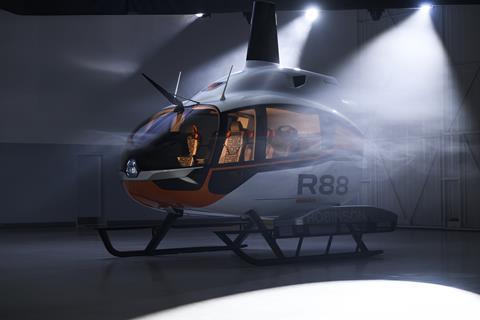
Speaking ahead of the European Rotors event, which runs from 17-20 November, Robinson chief executive David Smith tells FlightGlobal the first ground- and flight-test articles are “now in build”.
Based on the company’s current planning, Robinson is hopeful of performing ground runs of the R88 in late 2026 “and the first flight shortly after”.
“We feel pretty good that by the end of 2026 we should have an aircraft with air under its skids,” Smith says.
To support its push towards that target, Robinson is in the process of inaugurating a new drivetrain test rig; maturity of that system will be “a pacing item for our tests in the new year.”
Previous development programmes have not required such equipment but “this one is big enough and has enough horsepower in it that we need to do a good safety clearance and some endurance testing to make sure the system behaves as intended.”
Robinson’s schedule also hinges to some degree on when the airframer receives the R88’s first Arriel 2W turboshafts from supplier Safran Helicopter Engines.
Each R88 is powered by a single 950shp (710kW)-rated Arriel 2W and Smith says the firm is currently planning for engine delivery “in the summertime”.
While the Arriel is a long-running and highly mature programme – its earliest variant flew in 1974 – the 2W, the newest standard, still requires development time and to be matched with the R88’s characteristics, Smith notes.
“We expect this to be a fairly low-risk engine integration but there is a lot of work, and a lot of qualification and certification work on [Safran’s] side.”
Robinson and Safran have also been working with avionics supplier Garmin on the integration of their respective systems into the R88 where there has been “meaningful progress”, says Smith.
Elsewhere, Robinson is also testing several alternative designs for a new input driveshaft – taking the high-speed output from the engine to the transmission - as it is “trying to avoid some of the costly solutions [available]”.
Most other manufacturers solve the problem with flex-couplings, he says, “but we are trying to do it in a different way”.
“There are a couple of different versions in test right now. Those things are pretty exciting because it goes to the heart of Robinson – we want to solve a problem in an elegant way and one that cuts down on recurring cost and sustaining cost.”
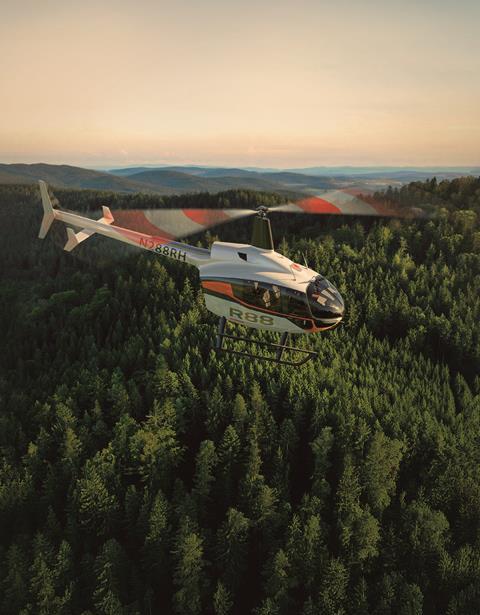
Although much of the R88 is new, its design leans on previous models in the Robinson range, for instance retaining the familiar hinged two-blade main rotor. “It’s the best two-blade design, period,” Smith adds.
Like the R88 itself, the main rotor blades are bigger than anything it has built before: the chord is a little over 40.6cm (16in) – around 35% wider than on the R66 – and around 1m longer at about 5.8m.
Parts for the main rotor and the main gearbox are in the process of being manufactured, he says.
But the heavy use of proven or already approved technology, such as Garmin’s G500H TXi avionics and autopilot, should also smooth the path to Federal Aviation Administration (FAA) approval, Smith argues.
Instrument flight rules certification for the smaller R66 – work being performed with the goal of securing a trainer contract with the US Army – will also speed the same qualification on the R88, he says.
Smith calls the new helicopter “the lowest-risk certification programme currently on the FAA’s docket”, citing the lack of “complexity” in the R88’s overall design.
On top which “it’s extremely low-risk to operators – it should be a drop-in to their fleets”, he says.
Robinson is targeting FAA approval before the end of the decade: “We’d be really happy if it was by 2028, even if 2029 is more likely,” adds Smith.
As it is still early in the development process, he remains guarded on the eventual maximum take-off weight but says it will be “under 6,000lb” – 2,720kg – “and the expectation is we can give half of that to the customer for useful load”.
To date, Robinson has taken around 150 commitments for the R88, although Smith is hopeful of substantially growing that total.
“We still have a couple of fleet opportunities that would significantly add to that – one that we hope to close before too long is upwards of 100 aircraft,” he says.
Meanwhile, the airframer is expecting a busy end to the year as it ramps up deliveries of its three current platforms – the piston-powered R22 and R44, and the Rolls-Royce turbine-powered R66.
While the forecast is for a total of 250-300 shipments for the full year, much depends on receiving the required engines, particularly from Rolls-Royce.
“I have a tremendous number of aircraft that are built minus engines,” says Smith, having chosen to maintain Robinson’s output for reasons of efficiency.
“We want to lean forward and put the emphasis on Rolls and give them the support they need and hope that someday soon they can outperform my build rate so we can clean up the finished goods that are hanging out waiting on engines,” he adds.