













The US Coast Guard (USCG) is investing in new aircraft engines and radars ahead of a planned expansion of its fixed- and rotary-wing fleets.
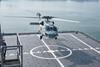
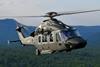
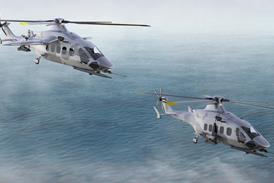
The service on 23 September revealed it has finalised a $14 million contract for 13 GE Aerospace T700 turboshafts, which power Sikorsky MH-60T Jayhawk medium-range search and rescue helicopters.
Separately, the USCG signed a $14 million deal with L3Harris covering three AN/APY-11 multi-mode radars, which will be installed on six new-build Lockheed Martin HC-130J fixed-wing search and rescue aircraft.
The funds are being allocated from a $3.3 billion pot of money allocated for modernising and expanding Coast Guard aviation under the so-called “One Big Beautiful Bill” spending package enacted by the Trump Administration and Congress over the summer.
Of the total, $2.3 billion has been set aside for producing and fielding new MH-60T helicopters and flight training simulators.
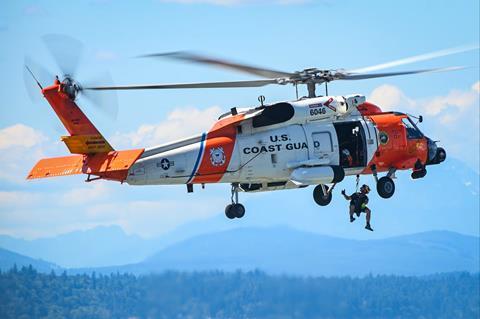
The USCG says the T700 engines are among long-lead components needed to expand the MH-60T fleet and to complete its pre-existing plan to replace Airbus Helicopters MH-65D/Es with MH-60Ts.
That sweeping transformation will see the Coast Guard’s rotary-wing fleet consolidate to 127 aircraft of a single type, down from a previous 146 aircraft, a 13% reduction.
In the process, all 94 of the USCG’s MH-65s are to be retired, while its existing fleet of 49 MH-60Ts will be expanded, albeit by a lesser amount.
Sikorsky is separately completing service-life extension work to the USCG’s existing MH-60Ts, adding 10,000h of life to each aircraft, all of which are more than 30 years old, according to fleets data from aviation analytics company Cirium. The rebuilt airframes will allow the USCG to operate the MH-60Ts until at least the 2040s.
The MH-65D/E retirement plan has been criticised by government auditors for leaving the service with fewer aircraft and without capabilities offered by the smaller MH-65s.
Still, the USCG is pressing ahead.
The service says buying T700 engines represents the start of long-lead-component acquisitions that will support its purchase of MH-60Ts.
Unlike MH-65D/Es, MH-60Ts can support the service’s full range of assigned missions, which include national security, law enforcement and search and rescue duties, the USCG says. “The aircraft’s ability to locate, identify and track surface targets day or night makes it a valuable search-and-rescue and law-enforcement asset.
“Transition of air stations is necessary to sustain rotary-wing capability as the MH-65E continues to face supportability issues driven by a diminishing supply base for an out-of-production aircraft,” the service adds.
US lawmakers have proposed requiring the USCG maintain a fleet of at least 140 aircraft, but that provision has not been approved.
The Trump Administration is increasingly leaning on the USCG to support homeland defence initiatives, having prioritised some military resources away from overseas threats and toward security issues in the Western Hemisphere.
USCG fixed-wing aircraft have also been diverted from search and rescue duties to support Washington’s sweeping push to deport migrant workers from the USA.
Those aircraft include HC-130J transports, which are set to receives significant upgrades under the recent USCG appropriation.
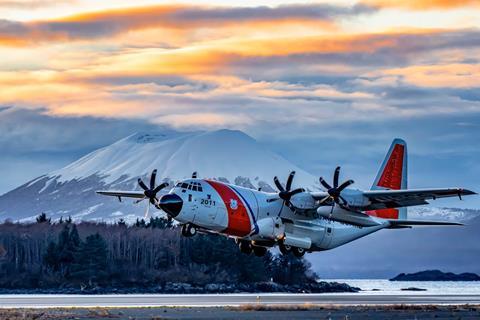
Approximately $1 billion from the $3 billion aviation modernisation fund is earmarked for purchasing and missionising six HC-130Js and one HC-130J simulator, the USCG’s first.
Its existing HC-130Js are also being upgraded with a new Minotaur Mission System avionics package, which the USCG says enables collection and correlation of sensor and track data. The Minotaur system was developed for the US Navy, allowing aircrews to gather and process surveillance information that can be transmitted to other platforms and operators mid-flight.
The capability will support a range of USCG missions, the service says, including maritime interdiction and search and rescue.
“The Coast Guard’s long-range surveillance fleet is a proven asset vital to control, secure and defend the US border and maritime approaches, facilitate commerce vital to economic prosperity, and respond to crises and contingencies,” the USCG says.
The HC-130J fleet will also continue providing logistics support to what are described as “routine operations” like deportation flights.